







工作機械と電気 No.14 抵抗
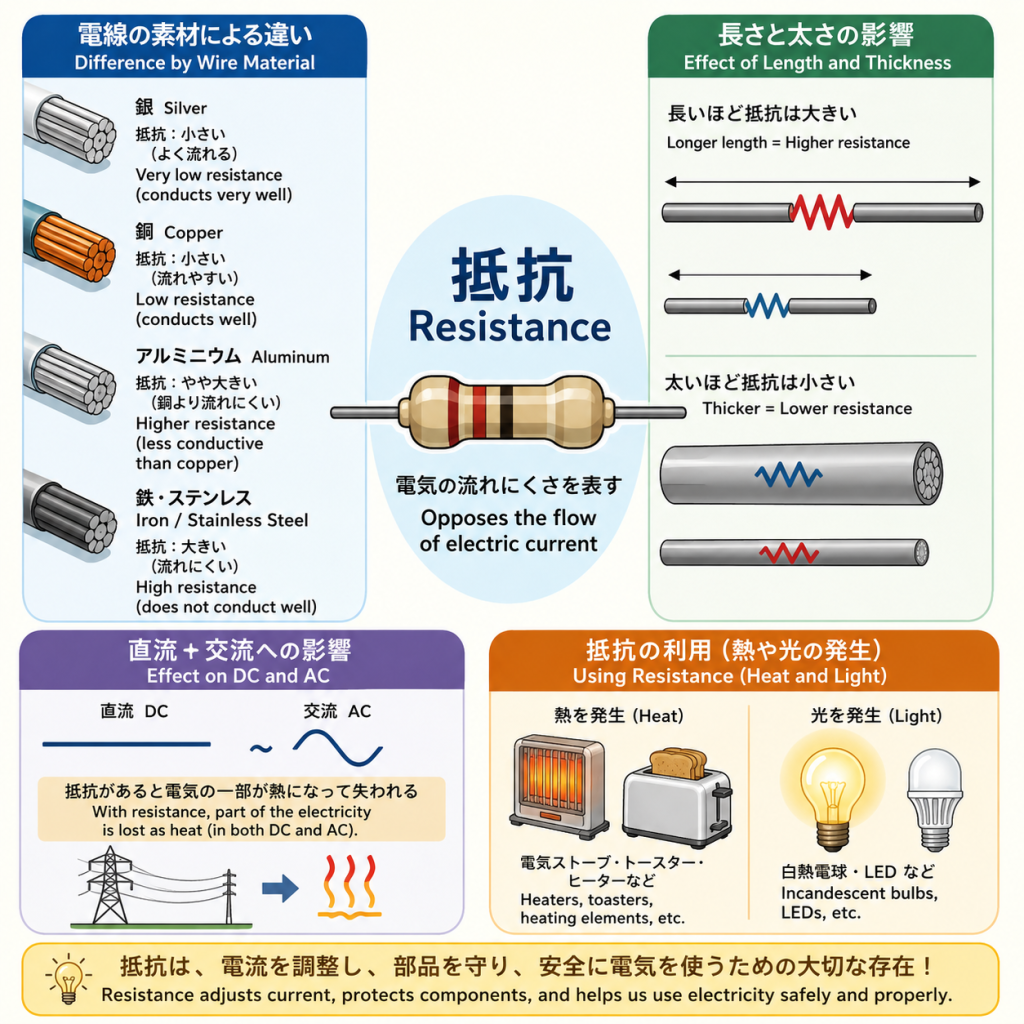
わかば:
やっほー、わかばです♪
わっ、何? 今回はイラスト付き?
こんなに詳しいのがあると、読んでもらえなくなっちゃうよ。
で、今回のテーマは「抵抗」?
もりお:
そう。前回までは、電圧や電流を中心に見てきたよね。
今回のテーマは、「抵抗」
わかば:
電圧は電気を流そうとする力で、
電流は実際に流れる電気の量だったよね。
もりお:
そうそう。
でも、電気は何の邪魔もなく、
好きなだけ流れるわけじゃない。
電気の流れにくさを表すものが、「抵抗」なんだ。
わかば:
抵抗って聞くと、
「ちょっと待った!」って止める感じだね。
もりお:
電気の世界でも、かなり近い。
抵抗が小さいと電流は流れやすく、
抵抗が大きいと流れにくくなる。
わかば:
電線の材料も関係するの?
ほら、電気を通しやすい物質とか、通さない物質とか、昔習ったなぁ。
もりお:
めっちゃ関係するよ。
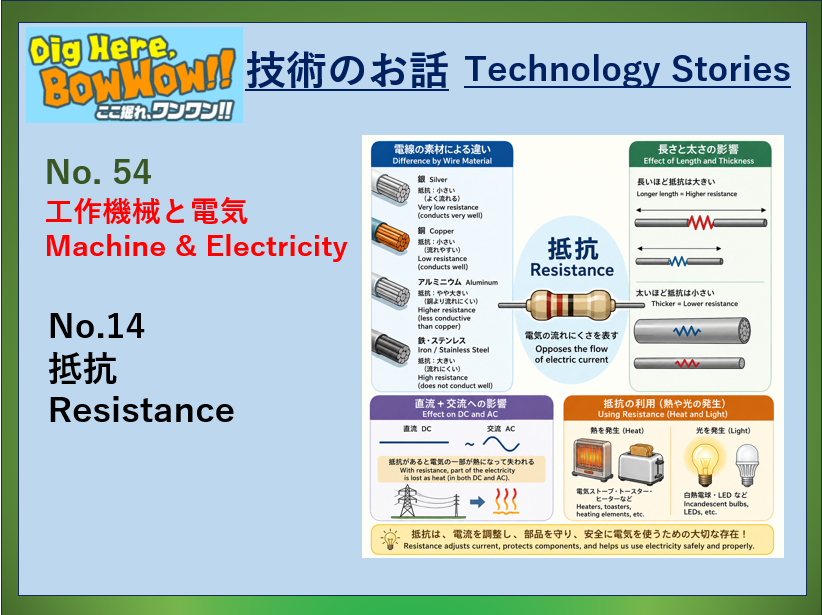
電線の素材によって、
電気の流れやすさが違うんだ。
代表的なのは、銀、銅、アルミニウム。
銀はとても電気を流しやすいけど、
高価だから、普通の電線にはあまり使われない。
わかば:
電線と言えば、銅っていうイメージはあるね。
もりお:
そう。
銅は電気を流しやすく、
曲げたり、つないだりもしやすい。
工作機械の配線にも、
銅線がよく使われているよ。
わかば:
アルミニウムは?
もりお:
アルミニウムは、銅より電気を流しにくい。
だから、同じ電流を流すなら、銅線より太くする必要があるんだ。
でも、軽くて価格も抑えやすいから、
送電線などで使われることがある。
わかば:
あー、バスバーで、そんな話してたな。
もりお:
その通り。
鉄やステンレスは、銅より抵抗が大きい。
だから、電気を効率よく運ぶ普通の電線には、
銅がよく使われるんだ。
わかば:
線の長さや太さも関係する?
もりお:
長い電線ほど抵抗は大きくなり、
太い電線ほど抵抗は小さくなるよ。
長くて細い道は混みやすく、
短くて太い道はスイスイ進める感じだね。
わかば:
前回まで、直流と交流を勉強したけど、
抵抗の影響は違うの?
もりお:
抵抗は、直流にも交流にも影響するよ。
どちらも電線に抵抗があると、
電気の一部が熱になって失われる。
特に大きな電流を流すほど、
電線が熱くなりやすいんだ。
わかば:
じゃあ、直流は抵抗があるから、
遠くまで送れないの?
もりお:
直流だから抵抗が大きい、
というわけじゃないよ。
昔は直流の電圧を
上げたり下げたりするのが難しかった。
低い電圧で大きな電力を送ろうとすると、
大きな電流が必要になって、
抵抗による損失が増えてしまったんだ。
わかば:
交流は電圧を変えやすいんだったよね。
もりお:
そうそう。
交流は変圧器を使って、
高い電圧、少ない電流で
遠くまで送りやすかった。
でも、今は技術が進んで、
直流も高い電圧で送れるようになり、
長距離送電に使われることもあるよ。
わかば:
へぇー。
抵抗って、電気をムダにする困り者だね?
もりお:
いや、わざと利用することもあるよ。
代表的なのが「熱」。
抵抗のある金属線に電流を流すと、
電気のエネルギーが熱に変わる。
わかば:
電気ストーブとか、トースターとか?
もりお:
その通り!
こうした機器では、
ニクロム線などを熱くしている。
工作機械でも、
制御盤のヒーターなどに
同じような仕組みが使われることがあるよ。
ただし、端子のゆるみや接触不良で
予定外の抵抗が大きくなると、
そこだけ発熱して危険なんだ。
だから、配線や端子の点検も大切だよ。
わかば:
必要な熱は便利だけど、
勝手に熱くなるのはヤバいね。
光も抵抗を利用して発生させるの?
もりお:
昔からある白熱電球では、
細いフィラメントに電流を流して、
高温で熱くすると、赤くなって、
さらには明るい光を出すんだ。
今よく使われるLEDは、別の仕組みで光るけど、
電流が流れすぎないように
抵抗器を組み合わせることがあるよ。
わかば:
フィラメントには、昔、竹が使われていたって
聞いたことがある。
ほら、わたしの名前は、光竹(みつたけ)若葉だから、
何か親しみを感じるな。
もりお:
エジソンたちは、電球のフィラメントに使える材料を
世界中で探したんだ。
その中で、京都の竹が長く光る材料として
実用化に役立ったんだよ。
とにかく、抵抗は、電気のエネルギーを熱や光に変えるだけでなく、
電流を調整したり、部品を守ったりもする。
電気を安全に、
正しく使うための大切な存在なんだ。
わかば:
電圧、電流、抵抗。
この3つは、どんな関係になっているの?
もりお:
そこが次のポイント!
次回は、電圧・電流・抵抗の関係を表す
「オームの法則」を見ていくよ。
わかば:
難しそう!
理解できるかな?
もりお:
大丈夫!
次回もわかりやすく伝えていくよ。
※本ブログは生成AIを活用して作成しています。
Machine & Electricity No.14 Resistance
Wakaba:
Ciao, it’s Wakaba!
Wow. Do we have an illustration this time?
With this detail illustaration, nobody is going to read our blog, are they?
Is Today’s topic “Resistance”?
Morio:
Yes.
So far, we’ve mainly been looking at voltage and current, right?
Today’s topic is “resistance.”
Wakaba:
Voltage is the force that tries to make electricity flow,
and current is the amount of electricity that actually flows, right?
Morio:
Exactly.
But electricity can’t just flow as much as it wants
without anything getting in its way.
“Resistance” tells us how difficult it is for electricity to flow.
Wakaba:
When I hear the word resistance,
it sounds like something saying, “Hold on!” and stopping the flow.
Morio:
That’s actually pretty close in the world of electricity.
When resistance is low, current flows easily.
When resistance is high, it has a harder time flowing.
Wakaba:
Does the material used for the wire matter too?
I remember learning about materials that conduct electricity easily and ones that don’t.
Morio:
It matters a lot.
Different wire materials
allow electricity to flow with different levels of ease.
Some typical examples are silver, copper, and aluminum.
Silver conducts electricity extremely well,
but it’s expensive, so it isn’t often used for ordinary wiring.
Wakaba:
When I think of electrical wires, I picture copper.
Morio:
Right.
Copper conducts electricity well,
and it’s also easy to bend and connect.
Copper wire is widely used
in the wiring of machine tools too.
Wakaba:
What about aluminum?
Morio:
Aluminum doesn’t conduct electricity as well as copper.
So, to carry the same current, an aluminum wire needs to be thicker than a copper wire.
But aluminum is lightweight and relatively inexpensive,
so it is sometimes used for power transmission lines.
Wakaba:
Oh yeah, we talked about something like that with busbars.
Morio:
Exactly.
Iron and stainless steel have higher resistance than copper.
That’s why copper is commonly used for ordinary wires
that need to carry electricity efficiently.
Wakaba:
Do the length and thickness of a wire matter too?
Morio:
The longer the wire, the higher its resistance.
And the thicker the wire, the lower its resistance.
It’s like a long, narrow road getting congested,
while traffic moves smoothly on a short, wide road.
Wakaba:
We learned about direct current and alternating current before.
Does resistance affect them differently?
Morio:
Resistance affects both direct current and alternating current.
In both cases, when a wire has resistance,
some electrical energy is lost as heat.
The larger the current,
the more easily the wire heats up.
Wakaba:
So, is direct current difficult to send over long distances
because of resistance?
Morio:
It’s not that direct current itself has higher resistance.
In the past, it was difficult
to raise or lower DC voltage.
When you try to transmit a large amount of power at a low voltage,
you need a large current,
which increases the losses caused by resistance.
Wakaba:
Alternating current makes it easier to change the voltage, right?
Morio:
Exactly.
Using transformers, alternating current could be transmitted over long distances
at high voltage and low current.
But technology has advanced,
and now direct current can also be transmitted at high voltage,
so it is sometimes used for long-distance power transmission too.
Wakaba:
Wow.
So resistance is kind of a troublemaker that wastes electricity?
Morio:
Not necessarily. Sometimes we use it on purpose.
A typical example is heat.
When current flows through a metal wire with resistance,
electrical energy is converted into heat.
Wakaba:
Like electric heaters and toasters?
Morio:
Exactly!
These appliances heat up materials such as nichrome wire.
In machine tools,
a similar principle may be used in heaters inside control panels.
However, if a loose terminal or poor connection
creates an unexpectedly high resistance,
that spot alone can heat up and become dangerous.
That’s why inspecting wiring and terminals is important.
Wakaba:
Useful heat is convenient,
but something heating up by itself sounds dangerous.
Can resistance be used to produce light too?
Morio:
In traditional incandescent light bulbs,
current flows through a thin filament.
When the filament becomes extremely hot, it first glows red
and then produces a bright light.
LEDs, which are commonly used today, produce light in a different way,
but a resistor may be used with them
to prevent too much current from flowing.
Wakaba:
I’ve heard that bamboo was once used for light bulb filaments.
You know, my name is Wakaba Mitsutake,
and the characters for Mitsutake mean “Shining Bamboo,”
so I kind of feel a connection to it.
Morio:
Edison and his team searched all over the world
for materials that could be used as light bulb filaments.
Among them, bamboo from Kyoto helped make practical light bulbs possible
because it could glow for a long time.
Anyway, resistance not only converts electrical energy into heat and light,
but also adjusts current and protects components.
It plays an important role in using electricity
safely and correctly.
Wakaba:
Voltage, current, and resistance.
How are these three related?
Morio:
That’s the next key point!
Next time, we’ll look at “Ohm’s law,”
which explains the relationship between voltage, current, and resistance.
Wakaba:
Sounds difficult!
Will I be able to understand it?
Morio:
No worries!
We’ll explain it clearly next time too.
Note: This blog was created with the hepl of generative AI.