












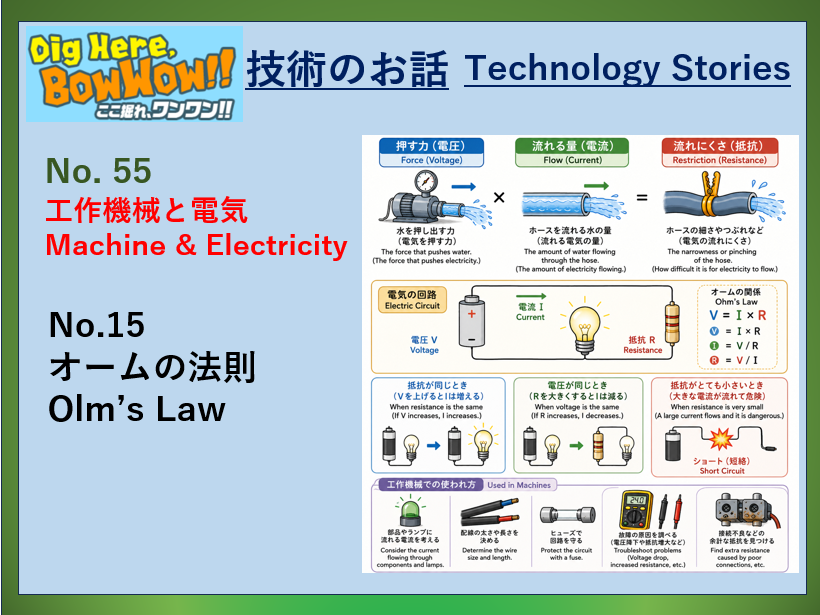
工作機械と電気 No.15 オームの法則
わかば:
やっほー、わかばです♪
今回のテーマは、「オームの法則」だっけ?
もりお:
そう。電気の世界で超重要な法則だよ。
わかば:
名前だけは聞いたことあるけど、
何のことか全然わかんない!
もりお:
オームの法則は、
これまで勉強してきた
「電圧」「電流」「抵抗」の関係を表す法則なんだ。
わかば:
電圧と電流と抵抗!
今まで別々に出てきた3つが、
ここでつながるんだね。
もりお:
そうそう。
まず簡単に復習すると、
電圧は、電気を流そうとする押す力。
電流は、実際に流れる電気の量。
抵抗は、電気の流れにくさだったよね。
わかば:
そこは覚えてる!
でも、その3つが
どんな関係になっているの?
もりお:
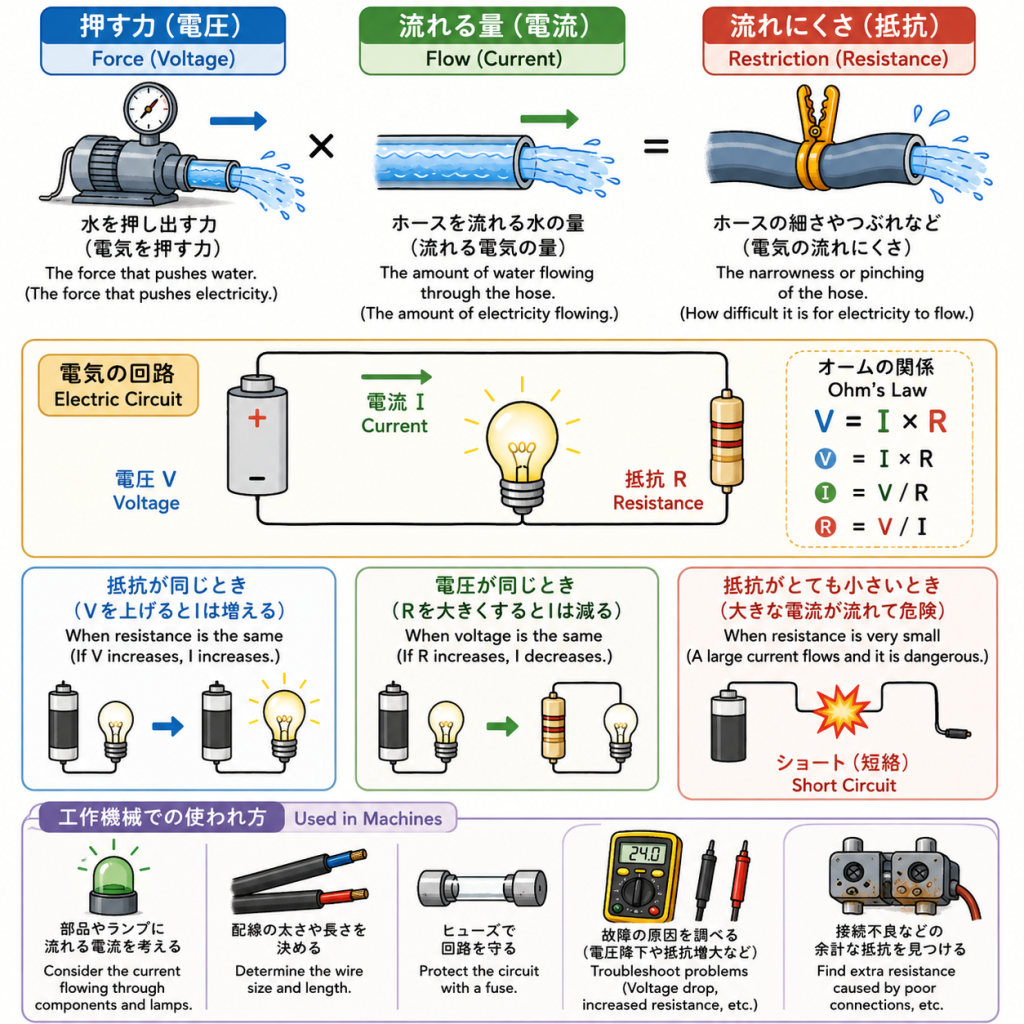
式で表すと、
電圧=電流×抵抗
になる。
記号を使うと、
V=I×R
わかば:
シンプルな式だけど、何だか難しそう!
もりお:
大丈夫。
水とホースで考えてみよう。
電圧は、水を押し出す力。
電流は、ホースを流れる水の量。
抵抗は、ホースの細さや、
水の流れを邪魔するものだと考えればいい。
わかば:
なるほど!
ポンプで水を押す力が強いほど、
ホースから勢いよく水が流れる。
それが電圧のイメージだね。
もりお:
その通り。
電気でも、抵抗が同じなら、
電圧を高くするほど電流は大きくなるんだ。
わかば:
じゃあ、
ホースの途中をギュッとつまんだら?
もりお:
水が流れにくくなるよね。
それが、抵抗が大きくなった状態。
同じ強さで水を押していても、
ホースが細くなったり、
途中がつぶれたりすると、
流れる水の量は減る。
わかば:
電気でも、
電圧が同じなら、
抵抗が大きくなるほど電流が減るんだね。
もりお:
バッチリ!
これがオームの法則の基本なんだ。
わかば:
水とホースで考えると、
式の意味がちょっと見えてきた!
もりお:
じゃあ、ちょっと数字でも見てみよう。
例えば、
抵抗が10オームの回路に
2アンペアの電流を流すには、
10オーム×2アンペア=20ボルト
つまり、20ボルトの電圧が必要になる。
わかば:
なるほど!
抵抗と流したい電流がわかれば、
必要な電圧が計算できるんだ。
もりお:
そういうこと。
オームの法則は、
知りたいものに合わせて、
式を3つの形に変えられるよ。
電圧を知りたいときは、
電圧=電流×抵抗
電流を知りたいときは、
電流=電圧÷抵抗
抵抗を知りたいときは、
抵抗=電圧÷電流
わかば:
なるほど、並べ替えだね。
電圧・電流・抵抗は、どれかが変わると、
ほかにも影響するってことだね。
もりお:
まず、抵抗が同じ場合。
抵抗が12オームなら、
12ボルトでは1アンペア。
24ボルトでは2アンペア流れる。
わかば:
電圧が2倍になったから、
電流も2倍になったんだね。
じゃあ、
電圧が同じ場合は?
もりお:
24ボルトの回路で、
抵抗が12オームなら2アンペア。
抵抗が24オームなら1アンペアになる。
わかば:
抵抗が2倍になったから、
電流は半分になった!
もりお:
その通り。
わかば:
この法則って、
実際の工作機械では、
どんな場面で使うの?
もりお:
いろいろな場面で使われているよ。
例えば、
24Vの制御回路に取り付ける
表示ランプや電子部品に、
どれくらいの電流が流れるかを考えるとき。
わかば:
前に勉強した、
センサーやリレーも24Vで動くことが多いんだよね。
もりお:
そうそう。
部品に流れる電流が大きすぎると、
発熱したり、部品が故障したりすることがある。
だから設計では、
電圧だけではなく、
電流や抵抗も確認する必要があるんだ。
わかば:
「24V用の部品だから大丈夫!」
だけではダメなんだね。
もりお:
そういうこと。
部品には、
使える電圧や電流の範囲が決められている。
その条件を超えないように、
回路を考える必要があるんだ。
わかば:
配線の太さを決めるときにも、
オームの法則は関係する?
もりお:
関係するよ。
電線にも抵抗がある。
電線が細すぎたり、
必要以上に長かったりすると、
抵抗が大きくなって、
電線の途中で電圧が失われ、
部品に届く電圧が下がることがある。
わかば:
電線も、
水を流すホースと同じように考えられるんだね。
細いホースだと、
たくさんの水を流しにくいもんね。
もりお:
いいイメージだね。
大きな電流を流す場所では、
電流に合った太さの電線を使う必要がある。
細すぎる電線に
大きな電流を流すと、
温度が上がって危険なんだ。
わかば:
だから、
適切な配線やヒューズが必要になるんだね。
もりお:
その通り。
ヒューズは、
異常に大きな電流が流れたときに回路を切って、
部品や配線を守る役割をしている。
わかば:
でも、
どうして急に大きな電流が流れることがあるの?
もりお:
代表的なのが「短絡」、
いわゆるショートだね。
わかば:
ショート!
それは危険って聞いたことある!
もりお:
ショートは、
電気が本来通るはずの部品を通らず、
抵抗のとても小さい道を
一気に流れてしまう状態なんだ。
わかば:
抵抗が小さくなると、
電流が大きくなるんだったね。
もりお:
そう。
「電流=電圧÷抵抗」だから、
抵抗が極端に小さくなると、
非常に大きな電流が流れる。
わかば:
水のホースで言えば、
流れを抑えていたものがなくなって、
水が一気に飛び出す感じ?
もりお:
そんなイメージだね。
大電流が流れると、
配線や部品が急激に発熱して、
破損したり、
場合によっては火災につながったりする。
わかば:
オームの法則がわかると、
ショートが危ない理由もわかるんだ!
もりお:
そうなんだ。
オームの法則は、
単なる計算のための式じゃない。
電気を安全に扱うための
大切な基本でもあるんだ。
わかば:
故障を調べるときにも使える?
もりお:
めちゃくちゃ使うよ。
例えば、
24Vあるはずの場所を測ったのに、
電圧が大きく下がっていたとする。
その場合、
配線の接続が緩んでいたり、
端子がさびていたりして、
余計な抵抗が発生している可能性がある。
わかば:
接続が悪いところが、
ホースのつぶれた部分みたいになるんだね。
もりお:
そうそう。
見た目ではつながっていても、
接触が悪いと電気は流れにくくなる。
その結果、
センサーが正しく反応しなかったり、
リレーが動かなかったり、
ランプが暗くなったりすることがある。
わかば:
電圧を測れば、
すぐに原因がわかるの?
もりお:
測っただけで、すぐに原因が決まるわけじゃないけど、
電圧、電流、抵抗の関係を考えながら、
回路図や部品の仕様と比べて、
異常がある場所を少しずつ絞り込んでいくんだ。
わかば:
電気の探偵だ!
もりお:
まさにそんな感じ(笑)
ただし、
測定するときには注意も必要だよ。
抵抗を測るときは、
基本的に回路の電源を切ってから測定する。
わかば:
電源を入れたままじゃダメなの?
もりお:
抵抗を測るとき、
測定器は自分で小さな電気を流して調べているんだ。
電源が入った回路で測ると、
正しく測れなかったり、
測定器を壊したりする危険がある。
わかば:
オームの法則だけじゃなくて、
正しい測り方も覚えないといけないんだね。
もりお:
そう。
電気は、
仕組みを理解することと、
安全な扱い方を守ることの両方が大切なんだ。
わかば:
今日の話をまとめると、
電圧は、電気を押す力。
電流は、実際に流れる量。
抵抗は、電気の流れにくさ。
抵抗が同じなら、
電圧を上げると電流が増える。
電圧が同じなら、
抵抗を大きくすると電流が減る。
そして、
ショートで抵抗が極端に小さくなると、
大電流が流れて危険!
ってことだね。
もりお:
完璧!
オームの法則は、
部品を選ぶとき、
配線やヒューズを決めるとき、
故障の原因を探すとき、
安全を考えるときなど、
いろいろな場面で使われている。
わかば:
ただのテスト用の計算式かと思ってたけど、
工作機械の設計や点検にも、
めっちゃ重要なんだね!
もりお:
そうなんだ。
式を覚えるだけではなく、
「なぜ電流が増えたのか」
「なぜ電圧が下がったのか」
「どこで電気が流れにくくなっているのか」
と考えるための土台になるんだ。
わかば:
電圧・電流・抵抗の関係がつかめた感じ!
オームの法則が超重要ってことがよくわかったよ!
でもさ……
電気って、
結局何をしてるんだろう?
もりお:
いい質問だね。
電気は、
モーターを回したり、
ランプを光らせたり、
電磁弁を動かしたり、
いろんな「仕事」をしているんだ。
わかば:
そう言われると、
「仕事」ってどういうことなんだろう?
もりお:
いいねぇ。次回はその辺りを掘っていこう!
※本ブログは生成AIを活用して作成しています。
Machine & Electricity No.15 Ohm's Law
Wakaba:
Ciao, it’s Wakaba!
Today’s topic is Ohm’s law, right?
Morio:
That’s right.
It’s one of the most important laws in the world of electricity.
Wakaba:
I’ve heard the name before,
but I have no idea what it actually means!
Morio:
Ohm’s law describes the relationship between
voltage, current, and resistance,
the three things we’ve been learning about.
Wakaba:
Voltage, current, and resistance!
So the three things we learned separately
are finally connected here.
Morio:
Exactly.
Let’s do a quick review first.
Voltage is the force that pushes electricity through a circuit.
Current is the amount of electricity actually flowing.
Resistance is how difficult it is for electricity to flow.
Wakaba:
I remember that part!
But how are those three connected?
Morio:
We can express the relationship with this formula:
Voltage = Current × Resistance
Using symbols, it becomes:
V = I × R
Wakaba:
It’s a simple formula,
but it still looks kind of difficult!
Morio:
Don’t worry.
Let’s think about water flowing through a hose.
Voltage is like the force pushing the water.
Current is like the amount of water flowing through the hose.
Resistance is like the narrowness of the hose
or anything that gets in the way of the water.
Wakaba:
I get it!
The harder a pump pushes the water,
the more strongly it flows through the hose.
That’s the image of voltage, right?
Morio:
Exactly.
With electricity, if the resistance stays the same,
a higher voltage causes a larger current to flow.
Wakaba:
Then what happens
if I squeeze the hose in the middle?
Morio:
The water becomes harder to flow, right?
That is like increasing the resistance.
Even if the water is pushed with the same force,
less water will flow if the hose becomes narrower
or gets crushed somewhere in the middle.
Wakaba:
So with electricity,
if the voltage stays the same,
the current decreases as the resistance increases.
Morio:
Perfect!
That’s the basic idea behind Ohm’s law.
Wakaba:
Thinking about water and a hose
makes the formula a little easier to understand!
Morio:
Now let’s take a quick look at some numbers.
For example,
to make a current of 2 amperes flow
through a circuit with a resistance of 10 ohms:
10 ohms × 2 amperes = 20 volts
So, a voltage of 20 volts is required.
Wakaba:
I see!
If we know the resistance
and how much current we want to flow,
we can calculate the required voltage.
Morio:
Exactly.
Depending on what you want to find,
Ohm’s law can be rearranged into three forms.
To find voltage:
Voltage = Current × Resistance
To find current:
Current = Voltage ÷ Resistance
To find resistance:
Resistance = Voltage ÷ Current
Wakaba:
I see.
We’re just rearranging the same formula.
So if voltage, current, or resistance changes,
it also affects the others.
Morio:
Let’s first look at a case
where the resistance stays the same.
If the resistance is 12 ohms,
1 ampere flows at 12 volts.
At 24 volts,
2 amperes flow.
Wakaba:
The voltage doubled,
so the current doubled too.
Then what happens
if the voltage stays the same?
Morio:
In a 24-volt circuit,
if the resistance is 12 ohms,
the current is 2 amperes.
If the resistance is 24 ohms,
the current becomes 1 ampere.
Wakaba:
The resistance doubled,
so the current was cut in half!
Morio:
Exactly.
Wakaba:
When is this law actually used
in a Machine?
Morio:
It’s used in many different situations.
For example,
when determining how much current will flow
through an indicator lamp or an electronic component
connected to a 24-volt control circuit.
Wakaba:
The sensors and relays we learned about before
often run on 24 volts too, right?
Morio:
Exactly.
If too much current flows through a component,
it can generate heat
or even fail.
That’s why electrical design requires checking
not only the voltage,
but also the current and resistance.
Wakaba:
So it’s not enough to say,
“It’s a 24-volt component, so everything is fine!”
Morio:
That’s right.
Each component has a specified range
of voltage and current that it can safely handle.
The circuit needs to be designed
so that those limits are not exceeded.
Wakaba:
Does Ohm’s law also matter
when choosing the thickness of a wire?
Morio:
Yes, it does.
Electrical wires also have resistance.
If a wire is too thin
or longer than necessary,
its resistance becomes larger.
Some voltage is then lost along the wire,
which can reduce the voltage
that actually reaches the component.
Wakaba:
So a wire can also be compared
to a hose carrying water.
A thin hose makes it harder
to carry a large amount of water.
Morio:
That’s a good way to think about it.
Where a large current needs to flow,
the wire must be thick enough
for that amount of current.
If a large current flows through a wire
that is too thin,
the wire can become dangerously hot.
Wakaba:
That’s why we need
the right wires and fuses.
Morio:
Exactly.
A fuse protects components and wiring
by cutting off the circuit
when an abnormally large current flows.
Wakaba:
But why would a large current
suddenly start flowing?
Morio:
A typical cause is a short circuit,
often simply called a “short.”
Wakaba:
A short circuit!
I’ve heard that it’s dangerous!
Morio:
A short circuit happens
when electricity bypasses the component
it was supposed to pass through
and suddenly flows through a path
with very little resistance.
Wakaba:
When the resistance becomes smaller,
the current becomes larger, right?
Morio:
Exactly.
Because:
Current = Voltage ÷ Resistance
If the resistance becomes extremely small,
a very large current can flow.
Wakaba:
Using the hose example,
is it like removing whatever was limiting the flow
and having the water rush out all at once?
Morio:
That’s the basic idea.
When a very large current flows,
wires and components can heat up rapidly.
They may be damaged,
and in some cases,
it can even cause a fire.
Wakaba:
Once you understand Ohm’s law,
you can also understand
why a short circuit is dangerous!
Morio:
Exactly.
Ohm’s law isn’t just a formula
for doing calculations.
It’s also an important foundation
for handling electricity safely.
Wakaba:
Can it also be used
when troubleshooting a problem?
Morio:
Absolutely.
For example,
suppose you measure a point
where there should be 24 volts,
but the voltage is much lower.
A loose wire connection
or a corroded terminal
may be creating extra resistance.
Wakaba:
So a bad connection is like
a crushed section of a hose.
Morio:
Exactly.
Even if the connection looks complete,
poor contact can make it harder
for electricity to flow.
As a result,
a sensor may not respond correctly,
a relay may not operate,
or a lamp may become dim.
Wakaba:
Can you find the cause right away
just by measuring the voltage?
Morio:
The measurement alone
doesn’t immediately tell you the cause.
You need to think about the relationship
between voltage, current, and resistance,
compare the readings with the circuit diagram
and the component specifications,
and gradually narrow down
where the problem is.
Wakaba:
It’s like being an electrical detective!
Morio:
Exactly! Ha ha!
But you also need to be careful
when taking measurements.
When measuring resistance,
you should basically turn off the power
to the circuit first.
Wakaba:
You can’t measure it
while the power is still on?
Morio:
When measuring resistance,
the measuring instrument sends
a small electrical current of its own
through the circuit.
If you measure a powered circuit,
the reading may be incorrect,
and the measuring instrument could be damaged.
Wakaba:
So it’s not enough
to understand Ohm’s law.
You also need to learn
the correct way to measure things.
Morio:
Exactly.
With electricity,
it’s important both to understand how it works
and to follow safe handling procedures.
Wakaba:
So, to sum up today’s lesson:
Voltage is the force that pushes electricity.
Current is the amount of electricity
actually flowing.
Resistance is how difficult it is
for electricity to flow.
If resistance stays the same,
raising the voltage increases the current.
If voltage stays the same,
increasing the resistance decreases the current.
And if the resistance becomes extremely small
because of a short circuit,
a dangerously large current can flow!
Is that right?
Morio:
Perfect!
Ohm’s law is used in many situations,
such as selecting components,
choosing wires and fuses,
finding the cause of a malfunction,
and considering electrical safety.
Wakaba:
I thought it was just a formula
for solving test questions,
but it’s actually super important
for designing and inspecting Machines too!
Morio:
Exactly.
It’s not just about memorizing a formula.
It gives us a foundation for thinking about questions like:
“Why did the current increase?”
“Why did the voltage drop?”
“Where is electricity having difficulty flowing?”
Wakaba:
I feel like I finally understand
the relationship between voltage, current, and resistance!
Now I really get
why Ohm’s law is so important!
But…
What is electricity actually doing?
Morio:
That’s a good question.
Electricity performs many different kinds of “work.”
It turns motors,
lights lamps,
and operates solenoid valves.
Wakaba:
Now that you mention it,
what does “work” actually mean?
Morio:
Nice question!
Next time,
let’s dig a little deeper into that.
Note: This blog was created with the hepl of generative AI.