



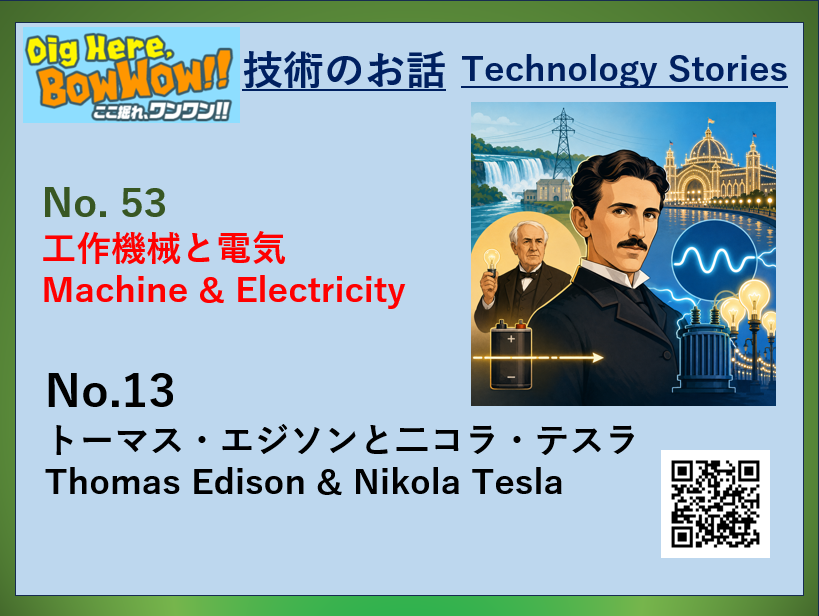
工作機械と電気 No.13 番外編 トーマス・エジソンとニコラ・テスラ
わかば:
やっほー、わかばです♪
今回は、エジソンとそのライバルの話って言ってたけど、誰のこと?
もりお:
そう、今回はちょっと番外編。
エジソンのライバルは、ニコラ・テスラって人。
ともに、19世紀後半から20世紀前半に生きた人だね。
わかば:
おお、急に歴史っぽい!
でも、初めて聞いた。
ライバル物語ってことは、発明家バトル回ってこと?
もりお:
電気の世界で有名なライバル関係だね。
特に今回は、ニコラ・テスラを中心に見ていくよ。
わかば:
テスラって、電気自動車の会社の名前にもなってるよね。
そんなにすごい人なの?
もりお:
めちゃくちゃすごい。
今の電力のしくみ、
特に「交流」を広げるうえで大きな役割を果たした人だよ。
わかば:
交流って、今やってる、
電気が行ったり来たりするやつだよね。
もりお:
そう。
当時、エジソンは「直流」を使った電力システムを進めていた。
そこにテスラが「これからは交流だ!」って考えたんだ。
わかば:
いきなり対立してたの?
もりお:
最初から敵だったわけじゃないよ。
テスラは若いころ、エジソンの会社で働いたことがあるんだ。
わかば:
え、元・同じチーム?
それはアツい展開!
もりお:
うん。
でも考え方が合わなかった。
エジソンは、実用化して、事業にして、広げる力が強い人。
テスラは、頭の中で仕組みを描いて、未来を見ていたタイプ。
わかば:
職人社長タイプと、天才研究者タイプみたいな感じ?
もりお:
かなり近いね。
エジソンは現実を動かす力がすごい。
テスラは発想のスケールがすごい。
どっちもバケモノ級。
わかば:
でも、そこで直流と交流の話になるんだね。
もりお:
そう。
エジソンの直流は、近い場所で使うにはわかりやすかった。
でも、遠くまで電気を送るには弱点があった。
わかば:
遠くまで送ると、電気が減っちゃう感じ?
もりお:
そう。
長距離で送るには、電圧を高くして送る方が有利。
交流は、変圧器で電圧を上げたり下げたりしやすい。
そこが超大きかった。
わかば:
テスラはそこに気づいたんだ。
もりお:
うん。
そして交流モーターや交流の送電システムを発展させた。
あとでウェスティングハウスという実業家と組んで、
交流の有用性を実際に世の中へ示していくんだ。
わかば:
ウェスティングハウス?
また強そうな名前出てきた!
もりお:
エジソンに対抗して、
交流をビジネスとして広げた重要人物だね。
テスラのアイデアを、現実の社会に近づけた人でもある。
わかば:
天才のアイデアを、
ちゃんと世の中で使える形にしたんだ。
もりお:
そう。
有名なのは、1893年のシカゴ万博の照明や、
1896年のナイアガラの滝を使った発電プロジェクト。
わかば:
何それ?もっと詳しく教えて。
もりお:
万博という世界中から人が集まる超ビッグイベントで、
照明の契約を勝ち取ったウェスティングハウス社が
交流を使って会場の照明をともしたんだ。
入札では、エジソン系の会社の半額近い数字だったらしいよ。
わかば:
え、それって今で言うと、
世界的イベントで新技術をドーンと見せる感じ?
もりお:
まさにそれ。
たくさんの電球が一斉に光る光景は、
当時の人にとってかなり衝撃的だったはず。
「交流って危ないんじゃないの?」
「本当に使えるの?」
という不安に対して、
実物で答えたわけだね。
わかば:
口で説明するより、
実際にピカーンと光らせた方が強いね。
もりお:
そう。
技術は、見せ方も大事。
「ちゃんと動く」
「大きな規模でも使える」
「人の生活を変えられる」
それを見せたのがシカゴ万博だった。
わかば:
これは交流チーム、かなり勢いづくね。
もりお:
さらにもう一つ、
交流の有用性を示した大きな出来事がある。
ナイアガラの滝を使った水力発電プロジェクトだよ。
わかば:
ナイアガラの滝!?
めちゃくちゃ大きい滝だよね!
もりお:
あの巨大な水の力を使って発電し、
35km程離れたニューヨーク州のバッファローという町まで送ることに成功したんだ。
ここで交流の長距離送電の強みが活きる。
わかば:
それはすごいね。
交流で、電気を遠くまで運べることを証明したんだ。
もりお:
そう。
ナイアガラの水力発電は、
交流が大規模な電力システムとして使えることを示した
象徴的なプロジェクトなんだ。
わかば:
すごい。
シカゴ万博で「交流は使えるぞ!」って見せて、
ナイアガラで「遠くまで送れるぞ!」って見せた感じ?
もりお:
まさにそう!
交流は、理論だけじゃなく、
実際の社会インフラとして存在感を強めていったんだ。
わかば:
エジソン側はどうだったの?
もりお:
エジソンは直流を強く推していた。
だから、交流との間で激しい競争になった。
この争いは「電流戦争」とも呼ばれているよ。
わかば:
名前がもう映画みたい。
でも、エジソンが悪者で、テスラが正義、
みたいな話なの?
もりお:
そう単純じゃない。
エジソンは、電気を生活に近づけた超重要人物。
テスラは、電気を遠くへ大きく届ける可能性を広げた人物。
役割が違うんだ。
わかば:
なるほど。
どっちも今の電気社会に必要だったんだね。
もりお:
そういうこと。
そしてテスラは、人物としてもかなり個性的だった。
わかば:
どんな感じ?
もりお:
両親がセルビア人で、
本人は、9ケ国語が使えるほどに語学に強く、
詩や音楽、哲学にも詳しかったんだって。
また、子どものころから強いイメージが頭に浮かぶことがあり、
頭の中で機械を動かして、
実物を作る前に、動きや不具合まで想像できたと言われている。
わかば:
脳内シミュレーション強すぎない?
まさに、天才って感じだね。
もりお:
すごいよね。
電気の現象に対する感覚が鋭くて、
「未来の電気社会」をかなり先まで見ていた。
わかば:
ちょっとSFの人みたい。
もりお:
そんな感じだね。
ただ、事業家としては苦労も多かった。
アイデアが先に行きすぎたり、
お金や契約の面でうまくいかなかったりしたんだ。
わかば:
天才だけど、世の中で成功し続けるのは別問題なんだね。
もりお:
うん。一方のエジソンは発明を事業にする力もすごかったって言われているしね。
技術は、発想だけでもダメ。
実用化、量産、保守、コスト、使う人の安心。
全部そろって、やっと社会に根づく。
わかば:
それ、工作機械にも通じるね。
すごい機能だけじゃなくて、
現場でちゃんと使えることが大事。
もりお:
その通り。
テスラの交流も、ただの理論じゃなく、
実際に送電できる、モーターを動かせる、
工場や町で使えると示したから広がった。
わかば:
エジソンとテスラの話、
ただの昔話じゃないね。
もりお:
そう。
今、工場に届く電気も、
機械の中で動くモーターも、
制御に使う電気も、
こうした歴史の積み重ねの上にあるんだね。
わかば:
昔のライバルたちの挑戦が、
今の工作機械につながってるって思うと、
なんかエモいね。
もりお:
うん。
電気は見えないけど、
そこにも人の工夫と挑戦の歴史がある。
わかば:
第13回は番外編っぽくて楽しかった!
テスラ、かなり推せる!
もりお:
いいね。
次に機械の電気を見るときも、
「この仕組みの後ろには歴史があるんだな」
って思うと、ちょっと見え方が変わるね。
※本ブログは生成AIを活用して作成しています。
Machine & Electricity No.13 Special Episode: Thomas Edison & Nikola Tesla
Wakaba:
Ciao, it’s Wakaba!!
You said this time we’re talking about Edison and his rival.
So, who was that?
Morio:
Right, this time is a little special episode.
Edison’s rival was a man named Nikola Tesla.
They both lived from the late 19th century into the early 20th century.
Wakaba:
Whoa, now it suddenly feels historical!
But I’ve never heard of him.
So, is this like an inventor battle episode?
Morio:
He’s famous as Edison’s rival in the world of electricity.
This time, we’ll focus mainly on Nikola Tesla.
Wakaba:
Tesla?
That’s also the name of an electric vehicle company, right?
Was he really that amazing?
Morio:
Super amazing.
He played a major role in spreading today’s electric power system,
especially “alternating current,” or AC.
Wakaba:
AC is the topic we’re talking about now, right?
Electricity that goes back and forth?
Morio:
Exactly.
At that time, Edison was promoting an electric power system using “direct current,” or DC.
Then Tesla came along with the idea,
“From now on, AC is the way to go!”
Wakaba:
Were they rivals right from the start?
Morio:
Not from the beginning.
When Tesla was young, he actually worked for Edison’s company.
Wakaba:
Wait, they were on the same team before?
That’s such a hot storyline!
Morio:
Yeah.
But their ways of thinking didn’t match.
Edison was strong at turning inventions into practical products,
building businesses around them, and spreading them to society.
Tesla was the type who imagined systems in his head
and looked far into the future.
Wakaba:
So, kind of like a craftsman-president type
versus a genius researcher type?
Morio:
That’s pretty close.
Edison had an incredible ability to move reality forward.
Tesla had an incredible scale of imagination.
Both of them were monster-level geniuses.
Wakaba:
And that’s where the DC and AC story comes in, right?
Morio:
Exactly.
Edison’s DC system was easy to understand
when electricity was used in nearby areas.
But it had a weakness when sending electricity over long distances.
Wakaba:
Like, the electricity gets weaker when it travels far away?
Morio:
That’s right.
For long-distance transmission,
it’s better to send electricity at a higher voltage.
With AC, it’s easy to raise or lower the voltage using a transformer.
That was a huge advantage.
Wakaba:
So Tesla noticed that.
Morio:
Yes.
He developed AC motors and AC power transmission systems.
Later, he teamed up with a businessman named Westinghouse
and showed the usefulness of AC to the world.
Wakaba:
Westinghouse?
Another name that sounds super powerful!
Morio:
He was an important person who promoted AC as a business
in competition with Edison.
He also helped bring Tesla’s ideas closer to real society.
Wakaba:
So he turned the genius’s ideas
into something the world could actually use.
Morio:
Exactly.
Famous examples include the lighting at the 1893 Chicago World’s Fair
and the power generation project using Niagara Falls in 1896.
Wakaba:
What are they?
Tell me more!
Morio:
The World’s Fair was a huge event
where people gathered from all over the world.
Westinghouse won the lighting contract
and used AC to light up the fairgrounds.
Apparently, his bid was nearly half the amount
offered by the Edison-related company.
Wakaba:
So, in today’s terms,
it was like showing off a new technology
at a massive global event?
Morio:
Exactly.
The sight of so many light bulbs shining all at once
must have been shocking to people at the time.
People were wondering,
“Isn’t AC dangerous?”
“Can it really be used?”
And AC answered those worries with the real thing.
Wakaba:
Instead of explaining it with words,
actually lighting everything up was way more powerful.
Morio:
Right.
How you show technology matters, too.
“It works properly.”
“It can be used on a large scale.”
“It can change people’s lives.”
The Chicago World’s Fair showed all of that.
Wakaba:
That must have given Team AC a huge boost.
Morio:
And there was one more major event
that showed the usefulness of AC.
The hydroelectric power project using Niagara Falls.
Wakaba:
Niagara Falls!?
That’s the giant waterfall, right?
Morio:
Yes.
They used the enormous power of the water to generate electricity
and successfully sent it to Buffalo, New York,
about 22 miles (35 kilometers) away.
This is where AC’s strength in long-distance transmission really mattered.
Wakaba:
That’s amazing.
It proved that AC could carry electricity far away.
Morio:
Exactly.
The Niagara hydroelectric project became a symbolic example
showing that AC could be used
as a large-scale electric power system.
Wakaba:
Wow.
So at the Chicago World’s Fair, they showed,
“AC can really be used!”
And at Niagara, they showed,
“AC can send electricity far away!”
Morio:
Exactly!
AC was not just a theory anymore.
It became more and more important
as real social infrastructure.
Wakaba:
What about Edison’s side?
Morio:
Edison strongly supported DC.
So there was intense competition between DC and AC.
This conflict is often called the “War of the Currents.”
Wakaba:
That name already sounds like a movie.
But was it like,
Edison was the bad guy and Tesla was the hero?
Morio:
It’s not that simple.
Edison was an extremely important person
who brought electricity closer to everyday life.
Tesla was the person who expanded the possibility
of delivering electricity farther and on a larger scale.
Their roles were different.
Wakaba:
I see.
So both of them were necessary
for today’s electric society.
Morio:
Exactly.
And Tesla himself was also a very unique person.
Wakaba:
What was he like?
Morio:
His parents were Serbian,
and Tesla himself was so good at languages
that he could use nine of them.
He was also familiar with poetry, music, and philosophy.
Also, since childhood, strong images would appear in his mind.
It is said that he could run machines in his head
and imagine their movement and even possible problems
before actually building them.
Wakaba:
His brain simulation skills were too strong!
That really sounds like a genius.
Morio:
It’s amazing.
He had a sharp sense for electrical phenomena
and seemed to be looking far ahead
toward the future of electric society.
Wakaba:
He sounds a bit like someone from science fiction.
Morio:
Yeah, kind of.
But as a businessman, he had many struggles.
His ideas were sometimes too far ahead,
and he didn’t always do well
with money or contracts.
Wakaba:
So even if you’re a genius,
continuing to succeed in society is a different issue.
Morio:
Right.
On the other hand,
Edison is said to have had an amazing ability
to turn inventions into business.
Technology can’t take root with ideas alone.
Practical use, mass production, maintenance, cost,
and peace of mind for the users.
Only when all of these come together
does technology truly take root in society.
Wakaba:
That connects to Machines, too.
It’s not enough to have amazing functions.
What matters is whether Machine can be used properly
on the actual shop floor.
Morio:
Exactly.
Tesla’s AC also spread because it was not just a theory.
It proved that electricity could be transmitted,
motors could be driven,
and factories and towns could actually use it.
Wakaba:
The story of Edison and Tesla
isn’t just an old story from the past.
Morio:
Right.
The electricity that reaches factories today,
the motors that move inside machines,
and the electricity used for control systems
all stand on top of this long history.
Wakaba:
When I think that the challenges of those old rivals
are connected to today’s machine tools,
it feels kind of emotional.
Morio:
Yeah.
Electricity is invisible,
but behind it, there is also a history
of human ideas and challenges.
Wakaba:
Episode 13 really felt like a special edition!
I’m totally becoming a Tesla fan!
Morio:
Nice.
Next time you look at the electricity inside Machine,
try thinking,
“There’s history behind this system.”
It might change the way you see it a little.
Note: This blog was created with the hepl of generative AI.