












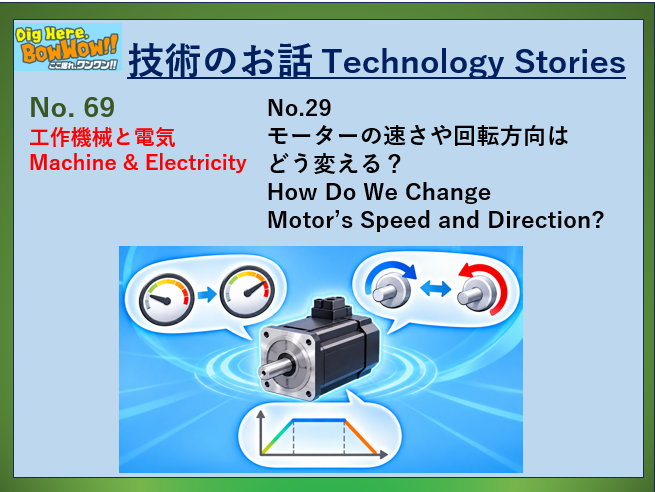
工作機械と電気 No. 29 モーターの速さや回転方向はどう変える?
わかば:
やっほー、わかばです♪
VF-615FTはおもしろかったね。
1つのモーターから複雑なばねを作る仕組みが
今のNC加工機に繋がる発想だなんて素敵だよね。
もりお:
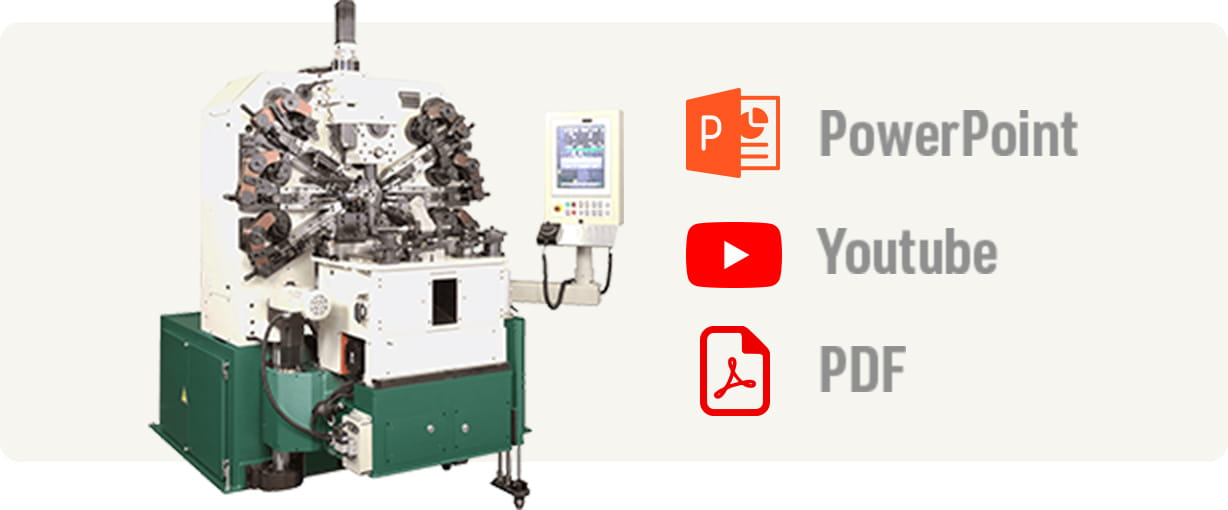
そうだね。YouTubeとも連携したから、
いろんな人にも見て欲しいね。
わかば:
ところで、前々回まで、モーターが回るしくみや、回り続けるしくみ、
モーターの中の部品について勉強してきたよね。
モーターとも、だいぶ仲良くなれた気がするなぁ(笑)。
もりお:
そうだね。
磁石、電磁石、磁界から始まって、モーターの構造まで勉強してきたからね。
わかば:
でも、モーターって、単に回転すればいいんじゃなくて、
速度を変えたり、反対向きに回したりも重要だよね。
どうやっているんだろう?
もりお:
そう、そこが今日のテーマ。
モーターの「速さ」と「回転方向」を変えるしくみについて勉強しよう。
わかば:
よしっ!
モーターを自由自在に操れるようになるぞ!
もりお:
操るのは、もう少し勉強してからかな(笑)。
まずは基本から始めよう。
モーターに電気を流すと、どうなるんだった?
わかば:
磁界ができて、その磁界と電流や磁石との関係から力が生まれて、モーターが回る!
もりお:
その通り。
じゃあ、電気の与え方を変えたらどうなると思う?
わかば:
う~ん。
回り方も変わるのかな?
もりお:
そうなんだ。
モーターは、電圧や電流の大きさ、向き、変化のさせ方などを調整することで、
回転する速さや方向を変えられるんだ。
ただし、モーターにはいろいろな種類があって、具体的な方法はそれぞれ違う。
今日は、基本的な考え方を見ていこう。
わかば:
OK。まずは速さから!
モーターを速く回すには、どうすればいいの?
もりお:
分かりやすい例として、乾電池で回る小さな直流モーターを考えてみよう。
モーターに加える電圧を高くすると、一般に回転が速くなるんだ。
わかば:
電圧って、電気を流そうとする力だったよね。
電圧を高くすると、モーターも元気よく回るんだ!
もりお:
そんなイメージだね。
ただし、電圧を高くすれば、どこまでも速く回せるわけじゃないよ。
モーターには使える電圧や回転速度の範囲があるからね。
わかば:
なるほど。
じゃあ、電圧を低くすれば、ゆっくり回るんだね。
もりお:
そう。
こうした直流モーターでは、電圧を調整することが、速さを変える基本的な方法の一つなんだ。
わかば:
意外とシンプルだね!
もりお:
もう一つ、身近な方法があるよ。
電気を細かくON・OFFして、モーターに与える電気を調整する方法なんだ。
わかば:
ON・OFF?
スイッチをパチパチ切り替えるの?
もりお:
そういうこと。
ただし、人間にはとてもできないくらい速く切り替えるんだ。
例えば、短い時間の中で、
ONの時間を長くしたり、
OFFの時間を長くしたりする。
わかば:
ONの時間が長ければ、たくさん電気を与える。
短ければ、少なくなるってこと?
もりお:
その通り。
短い時間を一区切りにして、
その中でONになっている時間の割合を変えるんだ。
こうして電気を与える割合を調整する方法を「PWM制御」というんだ。
わかば:
PWM?
全く聞いたこともない名前だ。
プロレスの団体みたい。
もりお:
今日は名前を覚えなくても大丈夫。
電気を細かくON・OFFして、モーターに与える電気を調整する方法がある、と分かれば十分だよ。
わかば:
了解!
ずっと電気を流すだけじゃなくて、細かく切り替える方法もあるんだね。
もりお:
そうなんだ。
ただし、今の話は小さな直流モーターを使った分かりやすい例だよ。
工作機械で使われるモーターでは、また違う方法も使われているんだ。
わかば:
工作機械のモーターは、もっと複雑なの?
もりお:
少しね。
前に「回転する磁界」の話をしたのを覚えている?
わかば:
もちろん覚えてるよ!
モーターの周りのコイルに流す電流を変化させて、磁界が回転するようにするんだったね。
もりお:
そう。
この回転する磁界の速さを変えることで、モーターの回転速度を調整する方法もあるんだ。
わかば:
あっ!
磁界が速く回れば、モーターも速く回る。
ゆっくり回れば、モーターもゆっくり回るってこと?
もりお:
基本的なイメージはそれでいいよ。
ただし、磁界の速さとモーターの実際の回転速度の関係は、モーターの種類によって違うんだ。
そのあたりは、モーターの種類を勉強するときに説明するね。
わかば:
なるほど。
電圧を変える方法もあれば、回転する磁界の速さを変える方法もある。
モーターによって、いろいろな工夫があるんだね。
もりお:
その通り。
わかば:
じゃあ次は、回転方向!
右回りだったモーターを、左回りにするにはどうするの?
もりお:
ここでも、まずは小さな直流モーターを考えてみよう。
乾電池につないだ2本の線を、反対につないだらどうなると思う?
わかば:
プラスとマイナスを逆にするってこと?
乾電池をプラスマイナス逆にしてはめてみるとして・・・、
う~ん・・・動かなくなる。
もりお:
そ、そうだね(笑)。
普通の電池式製品なら、逆に入れると動かなくなることが多いね。
でも今は、乾電池を小さなモーターに直接つないでいると考えてみよう。
永久磁石を使った一般的なブラシ付き直流モーターなら、
電流の向きが反対になって、回転方向も反対になるんだ。
わかば:
えっ、そんなに簡単なの!?
もりお:
そうなんだ。
以前、フレミングの左手の法則を勉強したよね。
磁界の向きが同じでも、電流の向きを反対にすると、力の向きも反対になるんだった。
わかば:
覚えてる!
親指が「こっちへ動け!」だったね(笑)。
もりお:
そうそう(笑)。
だから、電流の向きを変えることで、モーターの回転方向を変えられるんだ。
わかば:
なるほど!
前に勉強したことが、またつながった!
フレミングさんもなかなかやるね!
もりお:
ただし、これもモーターの種類によって方法が違うよ。
すべてのモーターが、電源のプラスとマイナスを逆にすれば反対に回るわけじゃないんだ。
わかば:
へぇー、じゃあ、工作機械で使うモーターは?
もりお:
例えば、回転する磁界を利用するモーターでは、
その磁界が回る方向を反対にする方法があるんだ。
わかば:
磁界の回る方向を変えるの?
もりお:
そう。
以前勉強したように、
周りのコイルに流す電流を順番に変化させると、回転する磁界ができる。
その変化の順番を反対にすれば、磁界の回転方向も反対にできるんだ。
わかば:
なるほど!
右回りに磁界を動かしていたのを、左回りにするんだね。
もりお:
そういうこと。
実際には、モーターを動かすための装置が、電流を適切に制御しているんだよ。
わかば:
モーターに電気を流すだけじゃなくて、
その電気を上手に調整する装置があるんだね。
もりお:
そう。
ここまでは、モーターを速く回したり、ゆっくり回したり、
回転方向を変えたりする基本的な方法を見てきたね。
わかば:
うん。電気の与え方を変えるんだったね。
もりお:
でも、工作機械では、それだけじゃ十分じゃないんだ。
例えば、モーターを速く回したいとき、
最初からその速さで回るわけじゃないよね。
わかば:
あっ、そうか!
止まっている状態から、だんだん速くなっていくんだね。
もりお:
そう。
つまり、「どのくらいの速さで回すか」だけじゃなく、
「いつ、どのように速さを変えるか」も大切なんだ。
わかば:
なるほど!
速さを決めるだけじゃなくて、
動いている途中の速さも考えないといけないんだね。
もりお:
その通り。
例えば、ばね加工機で材料を送ることを考えてみよう。
材料を100mm、高速で送りたいとき、
モーターが速く回りさえすればいいかな?
わかば:
それじゃダメだよね。
100mm送るところで、ちゃんと止まらないといけない!
もりお:
その通り。
止まる位置に近づいたら速度を落としたり、
必要なところで正確に停止したりする必要があるんだ。
わかば:
なるほど。
速く回るだけじゃダメで、
速さを変えるタイミングも大切なんだね。
もりお:
そうなんだ。
例えば、止まっている状態から急に最高速度で回すのではなく、
速度を上げていくことを「加速」、
反対に、速度を落としていくことを「減速」というんだ。
もっとも送り速度は、加工速度に直結する重要な点だから、
加減速も奥は深いんだ。
でも、今は「加速」と「減速」を覚えておこう。
わかば:
自動車と同じだね!
発進するときは加速して、止まるときは減速する。
もりお:
そう。
工作機械のモーターも、加速、一定速度、減速、停止という動きを組み合わせて使っているんだ。
わかば:
なるほど!
材料を速く送って、最後はきちんと止める。
ばね加工機では、これがとても大切だね。
もりお:
そうだね。
でも、もう一つ考えてみよう。
モーターに「材料を100mm送って」と指令したとして、
モーターが指令通りに回転したかどうかは、どうやって分かるかな?
わかば:
あっ!
以前勉強したエンコーダーだ!
もりお:
その通り。
エンコーダーなどで実際の回転を確認することで、
指令した動きと実際の動きを比べられるようになるんだ。
わかば:
なるほど!
「こう動いてほしい」と指令するだけじゃなくて、
「実際にどう動いたか」も確認するんだね。
もりお:
そう。
そして、その違いを見ながら電流などを調整して、狙った動きに近づけていく。
これが、工作機械でモーターを正確に動かすための大切な考え方なんだ。
わかば:
へぇ~。
モーターって、ただ電気を流して回すだけじゃないんだね。
もりお:
そうなんだ。
モーターを動かすには、
「どのくらい速く回すか」
「どちらの方向へ回すか」
そして、
「どこまで回して、どこで止めるか」
ということを考えなければいけないんだ。
わかば:
分かってきたぞ!
今日の内容をまとめてみるね。
モーターの速さは、電気の与え方を変えることで調整できる。
例えば、電圧を変えたり、電気を細かくON・OFFしたり、
回転する磁界の速さを変えたりする方法がある。
そして回転方向は、電流の向きや、回転する磁界の方向を変えることで切り替えられる。
でも工作機械では、それだけじゃ足りない。
加速や減速、停止する位置まで考えて、思い通りに動かすことが大切なんだね!
もりお:
バッチリ!
わかば:
モーターって、電気を与えれば勝手に回るものだと思っていたけど、
だんだん「電気をどう使うか」が大切だって分かってきたなぁ。
もりお:
いいところに気がついたね。
そして、モーターにはいろいろな種類があって、それぞれ得意なことも違うんだ。
わかば:
そういえば、何度も「モーターの種類によって違う」って言ってたよね。
どんな種類があるの?
もりお:
じゃあ次回は、モーターの種類と、それぞれの特徴を見ていこうか。
わかば:
おっ!
いよいよモーターの仲間たちが登場するんだね!
楽しみだなぁ♪
それでは、またね~!
<もりおのひとこと>
モーターは、電気の与え方を調整することで、
回転速度や回転方向を変えることができます。
ただし、その方法はモーターの種類によって異なります。
工作機械では、単にモーターを速く回したり、
反対方向へ回したりするだけでは十分ではありません。
必要な速度まで加速し、適切なタイミングで減速して、
狙った位置で正確に停止することが大切です。
そのためには、モーターだけでなく、電流を制御する装置や、
実際の回転を検出するエンコーダーなども重要な役割を果たしています。
モーターを「回す」ことから、「思い通りに動かす」ことへ。
これが工作機械の精度や性能につながっていくんですね
※このブログは、生成AIを活用して作成しています。
Machine & Electricity No. 29 How Do We Change a Motor’s Speed and Direction?
Wakaba:
Ciao, it’s Wakaba.♪
The VF-615FT was fascinating, wasn’t it?
It’s amazing that the idea of using a single motor to produce complex springs
has something in common with the way today’s NC Machines work!
Morio:
It certainly is.
We also linked the story with our YouTube video, so I hope lots of people will check it out.
Wakaba:
By the way, up until a couple of episodes ago,
we’d been learning how motors rotate, how they keep rotating,
and what components are inside them.
I feel like motors and I have become pretty good friends by now! (laughs)
Morio:
I think so too.
We started with magnets, electromagnets, and magnetic fields,
and worked our way up to the internal structure of motors.
Wakaba:
But motors aren’t just supposed to rotate, right?
It’s also important to change their speed or make them rotate in the opposite direction.
How do we do that?
Morio:
Exactly! And that’s today’s topic.
Let’s learn how to change a motor’s speed and direction of rotation.
Wakaba:
All right!
Soon I’ll be able to control motors any way I want!
Morio:
You might need a few more lessons before that! (laughs)
Let’s start with the basics.
What happens when electric current flows through a motor?
Wakaba:
It creates a magnetic field, and the interaction between the magnetic field, electric current, and magnets
produces a force that makes the motor rotate!
Morio:
Exactly.
Now, what do you think would happen if we changed the way we supply electricity?
Wakaba:
Hmm…
Would that change the way the motor rotates?
Morio:
That’s right.
By adjusting things like voltage, the amount and direction of current,
and how the current changes, we can control a motor’s speed and direction.
However, there are many types of motors,
and the specific methods differ depending on the type.
Today, let’s focus on the basic ideas.
Wakaba:
OK! Let’s start with speed!
How can we make a motor spin faster?
Morio:
For a simple example, let’s think about a small DC motor powered by a battery.
Generally, increasing the voltage applied to the motor makes it rotate faster.
Wakaba:
Voltage is the force that pushes electric current through a circuit, right?
So when we increase the voltage, the motor spins more energetically!
Morio:
That’s a good way to picture it.
But increasing the voltage doesn’t mean we can make the motor spin faster and faster without limit.
Every motor has a specified operating range for voltage and rotational speed.
Wakaba:
I see.
So if we lower the voltage, the motor rotates more slowly.
Morio:
Exactly.
For this type of DC motor, adjusting the voltage is one of the basic ways to control its speed.
Wakaba:
That’s surprisingly simple!
Morio:
There’s another common method.
We can control the electricity supplied to the motor by switching it ON and OFF very rapidly.
Wakaba:
ON and OFF?
Like flicking a switch back and forth?
Morio:
Exactly.
But much faster than any human could possibly do!
For example, within a very short period of time, we can make the ON time longer or the OFF time longer.
Wakaba:
So if the ON time is longer, the motor gets more electricity.
And if it’s shorter, the motor gets less?
Morio:
That’s right.
We divide time into short, repeating intervals and adjust the proportion of each interval
during which the power is ON.
This method is called “PWM control,” which stands for Pulse Width Modulation.
Wakaba:
PWM?
I’ve never heard of that before.
Morio:
You don’t need to remember the name today.
For now, it’s enough to understand
that we can control the electricity supplied to a motor by switching it ON and OFF very rapidly.
Wakaba:
Got it!
So instead of supplying electricity continuously,
we can also control it by switching it on and off in tiny intervals.
Morio:
Exactly.
But remember, we’ve been using a small DC motor as a simple example.
Motors used in Machines can use different methods.
Wakaba:
Are motors used in Machines more complicated?
Morio:
A little.
Do you remember when we talked about a “rotating magnetic field”?
Wakaba:
Of course I do!
By changing the current flowing through the coils around the motor,
we can create a magnetic field that rotates.
Morio:
Exactly.
Another way to control a motor’s speed is to change the speed of that rotating magnetic field.
Wakaba:
Oh, I get it!
If the magnetic field rotates faster, the motor spins faster.
And if it rotates more slowly, the motor slows down too?
Morio:
That’s the basic idea.
However, the relationship between the speed of the rotating magnetic field and the motor’s actual rotational speed
depends on the type of motor.
We’ll explain that when we study the different types of motors.
Wakaba:
I see.
Some motors change speed by adjusting voltage, while others do it
by changing the speed of a rotating magnetic field.
There are all kinds of clever ways to control motors!
Morio:
Exactly.
Wakaba:
Now, let’s talk about direction!
How do we make a motor that’s rotating clockwise turn counterclockwise instead?
Morio:
Let’s start with our small DC motor again.
What do you think would happen if we reversed the two wires connected to the battery?
Wakaba:
You mean swapping the positive and negative connections?
Let me imagine putting a battery into something the wrong way around…
Hmm… It wouldn’t work!
Morio:
W-well, yes! (laughs)
With ordinary battery-powered devices,
putting the battery in backward often means they won’t work.
But this time, imagine connecting the battery directly to a small motor.
With a typical permanent-magnet brushed DC motor,
reversing the connections reverses the direction of the current,
causing the motor to rotate in the opposite direction.
Wakaba:
What?! Is it really that simple?!
Morio:
It is.
Remember when we learned about Fleming’s left-hand rule?
If the direction of the magnetic field stays the same but the direction of the current is reversed,
the direction of the force is reversed too.
Wakaba:
I remember!
The thumb was the one saying, “Move this way!” (laughs)
Morio:
That’s right! (laughs)
So by reversing the direction of the current, we can reverse the motor’s rotation.
Wakaba:
I see!
Something we learned earlier is coming together again!
That Fleming guy really knew his stuff!
Morio:
But once again, the method depends on the type of motor.
Not every motor will reverse direction simply
by swapping the positive and negative power connections.
Wakaba:
Oh, really? Then how about motors used in Machines?
Morio:
For example, with motors that use a rotating magnetic field,
we can reverse the direction in which that magnetic field rotates.
Wakaba:
Reverse the direction of the magnetic field?
Morio:
Exactly.
As we learned before, changing the currents flowing through the surrounding coils in a particular sequence
creates a rotating magnetic field.
By reversing that sequence, we can reverse the direction of the rotating magnetic field.
Wakaba:
I see!
So instead of making the magnetic field rotate clockwise, we make it rotate counterclockwise!
Morio:
Exactly.
In practice, a device that drives the motor controls the currents appropriately to make this happen.
Wakaba:
So it’s not just about supplying electricity to the motor.
There’s also a device that carefully controls that electricity!
Morio:
That’s right.
So far, we’ve looked at the basic ways to make a motor spin faster or slower, or change its direction of rotation.
Wakaba:
Right. It’s all about changing how we supply electricity.
Morio:
But in Machines, that alone isn’t enough.
For example, when we want a motor to run at high speed,
it can’t instantly jump from a standstill to that speed, can it?
Wakaba:
Oh, that’s true!
It has to start from a standstill and gradually speed up.
Morio:
Exactly.
So it’s not just about “how fast we want it to rotate.”
We also need to think about “when and how to change its speed.”
Wakaba:
I see!
We need to decide not only the speed itself,
but also how the speed changes while the motor is moving.
Morio:
That’s right.
For example, think about feeding wire in a spring-making Machine.
If we want to feed 100 mm of wire at high speed,
is it enough just to make the motor spin fast?
Wakaba:
Of course not!
It has to stop at exactly the right point after feeding 100 mm!
Morio:
Exactly.
We need to slow the motor down
as it approaches the stopping position and bring it to a precise stop.
Wakaba:
I see.
So it’s not enough just to rotate quickly.
The timing of speed changes is important too!
Morio:
That’s right.
For example, instead of instantly jumping from a standstill to maximum speed,
the motor increases its speed. This is called “acceleration.”
And when it reduces its speed, that’s called “deceleration.”
Of course, wire-feeding speed directly affects production speed,
so there’s a lot more to acceleration and deceleration than you might think.
But for now, let’s just remember those two terms.
Wakaba:
Just like driving a car!
You accelerate when you start moving and decelerate when you’re about to stop.
Morio:
Exactly.
Motors in Machines also combine acceleration, constant-speed operation, deceleration, and stopping.
Wakaba:
I see!
Feed the wire quickly, then stop it precisely at the right position.
That’s really important in a spring-making Machine!
Morio:
It certainly is.
But let’s think about one more thing.
Suppose we give the motor a command to “feed 100 mm of wire.”
How can we tell whether the motor actually rotated as commanded?
Wakaba:
Oh!
The encoder we learned about before!
Morio:
Exactly.
By using an encoder or similar device to detect the motor’s actual rotation,
we can compare the commanded motion with what the motor really did.
Wakaba:
I see!
So instead of just telling the motor, “This is how I want you to move,”
we also check, “How did you actually move?”
Morio:
Exactly.
By monitoring the difference and adjusting the current and other control parameters,
we can make the motor follow the intended motion more accurately.
This is one of the key ideas behind precise motor control in Machines.
Wakaba:
Wow!
There’s a lot more to motors than just supplying electricity and making them spin!
Morio:
There certainly is.
To control a motor, we need to think about:
“How fast should it rotate?”
“Which direction should it rotate?”
And,
“How far should it rotate, and where should it stop?”
Wakaba:
I think I’ve got it!
Let me sum up what we learned today.
We can control a motor’s speed by changing how electricity is supplied.
For example, we can adjust the voltage, switch the electricity ON and OFF very rapidly,
or change the speed of a rotating magnetic field.
We can also change the direction of rotation
by reversing the direction of the current or the rotating magnetic field.
But in Machines, that’s not enough.
We also need to consider acceleration, deceleration,
and the exact stopping position to make the motor move just the way we want!
Morio:
Perfect!
Wakaba:
I used to think a motor was something that simply spun when you supplied electricity.
But now I’m beginning to understand that what really matters is “how we use electricity.”
Morio:
That’s a great observation.
And there are many different types of motors, each with its own strengths and characteristics.
Wakaba:
Come to think of it, you’ve said “it depends on the type of motor” quite a few times today.
What kinds of motors are there?
Morio:
Then next time, let’s look at the different types of motors and what makes each one special.
Wakaba:
Oh!
So we’re finally going to meet the different members of the motor family!
I can’t wait!♪
See you next time!
<morio’s note=””></morio’s>
By adjusting how electricity is supplied,
we can change a motor’s rotational speed and direction.
However, the methods used depend on the type of motor.
In Machines, simply making a motor rotate faster or in the opposite direction is not enough.
It is important to accelerate to the required speed, decelerate at the appropriate time,
and stop precisely at the intended position.
To achieve this, not only the motor itself but also the devices that control the current and components
such as encoders that detect actual rotation play important roles.
From simply “making a motor rotate” to “making it move exactly as intended.”
That’s what helps determine the precision and performance of a Machine.
Note:This blog is created with the help of generative AI.