








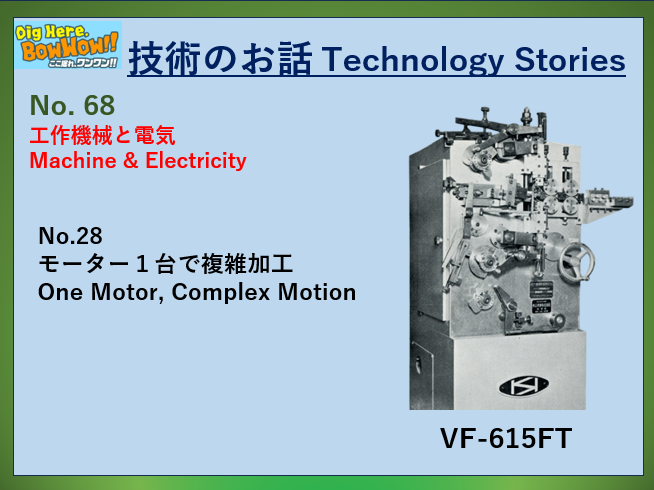
工作機械と電気 No. 28 昔の工作機械は、どうやって複雑な動きを作ったの? ~VF-615FTの知恵と工夫~
わかば:
やっほー、わかばです♪
前回は、昔と今ではモーターの役割がずいぶん変わったことを勉強したよね。
昔の工作機械では、モーターは「力を出す係」で、
ギアやカムなんかを使って複雑な動きを作っていたんだったね。
もりお:
そうそう。
今はサーボモーターを細かく制御して、材料を送ったり、ツールを動かしたりしているけど、
昔は機械的な仕組みで動きを作っていたんだ。
わかば:
今日はVF-615FTを紹介してくれるんだよね!
ばね技術遺産に認定されたんでしょ?
もりお:
そうだよ。
VF-615FTは、1970年(昭和45年)に開発され、販売を開始したばね加工機で、
「ユニバーサルマシン」と呼ばれていたんだ。
当時、ばねの形が複雑になる中で、
いろいろな加工に対応するために開発されたばね加工機なんだ。
わかば:
ユニバーサルって、いろんなことができるって意味だよね。
どんなばねが作れたの?
もりお:
引張ばねやトーションばねなんだけど、
特に、乾電池を両端から押さえる接点ばねの加工で活躍したそうだよ。
材料を何回も送ったり、送り長さを変えたり、
いろいろな加工ユニットを動かしたりして、複雑な形のばねを作ることができたんだ。
わかば:
でも、前回の話では、主な加工機構を動かす原動モーターは1台だったんだよね。
どうやって、そんな複雑な動きを作ったの?
もりお:
よしっ、どんな工夫があったのか、順番に見てみよう。
わかば:
楽しみ~♪
もりお:
まず、ばね加工で大切なのは、材料を送ることだよね。
例えばフックを作る場合、材料を少し送って曲げ、また送って曲げる。
そんな動きを何回も繰り返す必要があるんだ。
わかば:
そうだね。
ほら、ばね加工の原理によると、
曲げ加工の時は、ワイヤーを送っちゃダメなんでしょ。
でも、原動モーターはずっと回っている・・・
どうやって材料を送ったり、止めたりしていたの?
もりお:
そこで登場するのが、セグメントギアとワンウェイクラッチなんだ。
わかば:
また新しい名前だ(笑)。
どんな仕組みなの?
もりお:
セグメントギアは、扇形のような形をしたギアだよ。
原動モーターの回転を利用して、このギアを行ったり来たりさせるんだ。
わかば:
行ったり来たり?
それじゃあ、送りローラがせっかくワイヤーを送っても、
また戻っちゃうよ。
もりお:
普通ならそうなるよね。
でも、ワンウェイクラッチを使うと、
一方向に回るときだけ動力を伝えて、
反対方向では空転させることができるんだ。
わかば:
なるほど!
行きでは材料を送って、戻りではクラッチが空転する。
モーターは回り続けているのに、材料は必要なときだけ送れるんだね。
もりお:
その通り。
さらに、チェンジギアやいろいろな機構を工夫して、
送り長さを変えたり、長い送りや正確な送りを実現したりしていたんだ。
わかば:
へぇ~、すごいね。
ギアとクラッチを組み合わせるだけでも、いろんなことができるんだね。
わかば:
ワイヤー送りはわかったけど、それだけじゃ、ばねは作れないよね。
曲げたり、切断したりするのはどうしていたの?
もりお:
そこではカムが活躍するんだ。
わかば:
カムって、回転する部品の形を工夫して、
ツールの直線運動を作る仕組みだったよね?
もりお:
よく覚えていたね。
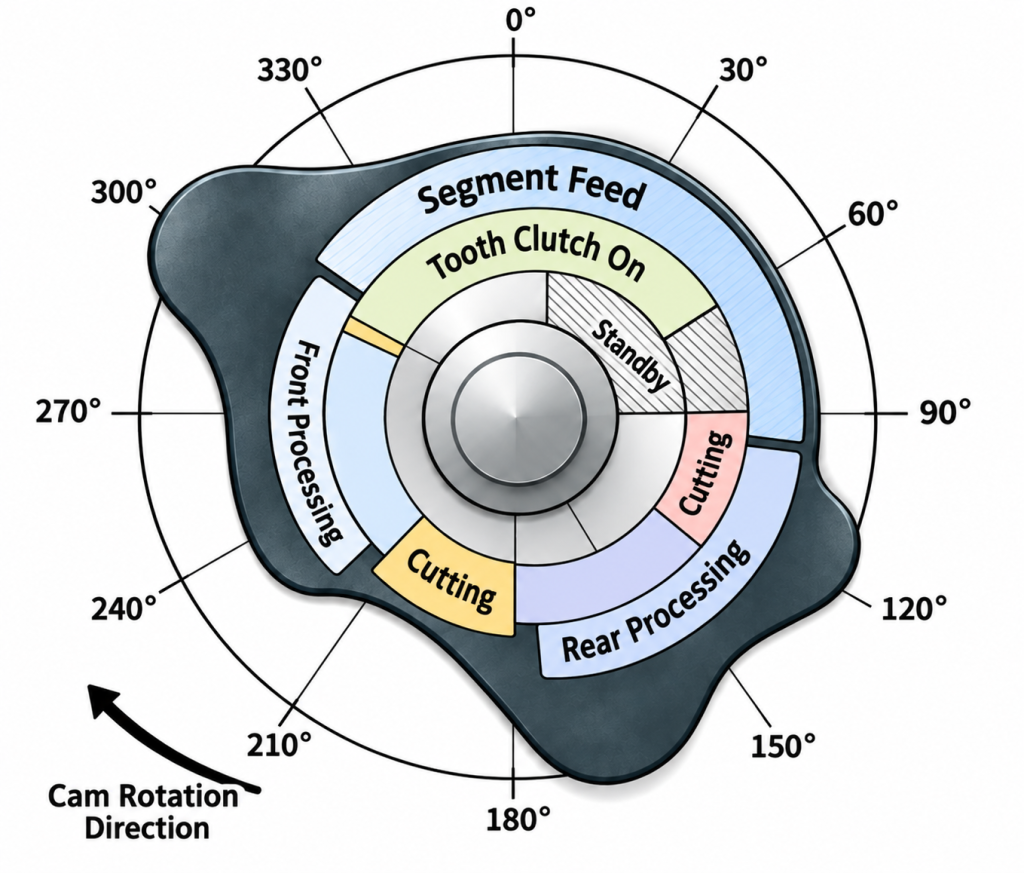
例えば、カムを回すことで、加工ユニットを上下や左右に動かすことができるんだ。
VF-615FTでは、複数のカムを組み合わせて、曲げ加工や切断などを行っていたんだよ。
わかば:
つまり、カムの形によって、いつ、どれくらいツールを動かすのかが決まるんだね。
もりお:
そういうこと。
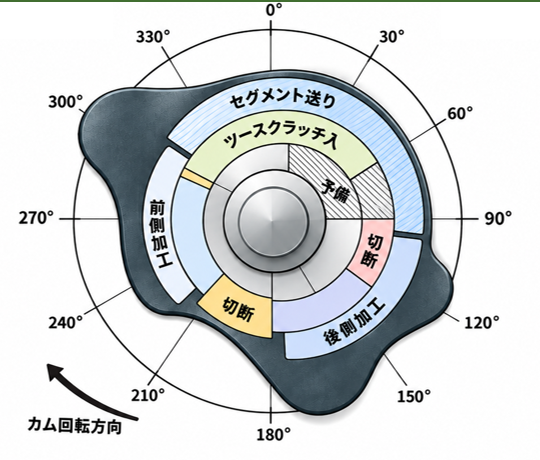
実際に使われていた加工用カムの図面を見ると、なかなか面白いよ。
わかば:
わぁ、めちゃめちゃ大変そう!
こんな形を考えて、実際に複雑な動きを作っていたんだね。
もりお:
そう。
加工したいばねの形に合わせて、
カムの形状や動くタイミングを設計していたんだ。
今ならプログラムで設定するような動きを、
当時は機械の形として作り込んでいたんだね。
わかば:
なんだか、カムそのものがプログラムみたいだね!
もりお:
面白い考え方だね。
もちろん、現在のソフトウェアほど自由に変更できるわけではないけど、
加工の順番やタイミングを決めるという意味では、共通する発想があるんだ。
わかば:
でも、ちょっと気になることがあるんだけど。
材料を送るのも、ツールを動かすのも、全部タイミングを合わせないといけないんでしょ?
そんなにたくさんの動きを、さっきのセグメントギアが戻る間だけで
どうやって組み合わせていたの?
もりお:
そこがVF-615FTの大きな工夫なんだ。
当時のカム式ばね加工機では、加工の1サイクルを360度として、
材料送りや曲げ、切断などのタイミングを決めていたんだよ。
わかば:
360度って、ぐるっと1回転だね。
もりお:
そう。
ただし、これは原動モーターが1回転するという意味ではなく、
加工サイクルを表す角度なんだ。
わかば:
でも、その360度からワイヤー送りを除いたところに
全部の動きを入れないといけないんだよね?
もりお:
そうなんだ。
例えば、材料送りを止めてから曲げる加工では、
送りと加工に使える時間を、うまく配分する必要があったんだ。
わかば:
それじゃあ、複雑なばねになって、曲げ加工が増えたら、
時間が足りなくなりそうだね。
もりお:
まさにそこが問題だったんだ。
そこでVF-615FTでは、ギア比を工夫して、
カムが1回転する間にセグメントギアを2往復させる仕組みを採用したんだよ。
わかば:
えっ、1サイクルの中で2往復?
もりお:
そう。
さらに、ツースクラッチという、電気信号によって噛み合わせたり、切り離したりして、
動力の伝達を切り替える仕組みも使っていたんだ。
わかば:
それは何のため?
もりお:
セグメントギアが動いていても、材料を送りたくないときには、
クラッチを切り離して送りを止めることができるんだ。
そうすることで、加工に使える角度を増やせるようにしたんだよ。
わかば:
なるほど!
360度という限られた範囲の中で、材料送りと加工の時間をやりくりしていたんだね。
もりお:
そういうこと。
ギア比やクラッチを工夫することで、多段送りと複雑な加工を両立させていたんだ。
わかば:
なんだか、360度の中に、いろんな動きを詰め込むパズルみたいだね(笑)。
もりお:
確かに、そんな感じだね(笑)。
わかば:
ここまで聞くと、VF-615FTってすごい機械だったんだね。
でも、今のNC加工機とは、やっぱり全然違うのかな?
もりお:
動きを作る方法は大きく違うね。
現在のNC加工機では、サーボモーターを使って、
それぞれの軸の位置や速度、動くタイミングを細かく制御できる。
わかば:
昔はギアやカム、クラッチを組み合わせていたけど、
今はモーターと制御で動きを作っているんだね。
もりお:
そうだね。
でも、ちょっと考えてみて。
VF-615FTで実現しようとしていたのは、どんなことだったかな?
わかば:
えーっと、
材料を長く送ったり、何回も送ったり、
いろんなツールを動かしたり、
加工のタイミングを合わせたりすることかな。
もりお:
その通り。
実は、それらは現在のNC加工機でも大切な機能なんだ。
実現する技術は変わっても、加工で必要とされることには共通点があるんだね。
わかば:
あっ、そうか!
今のNC加工機につながる発想が、もうVF-615FTにあったんだね。
もりお:
そういうこと。
VF-615FTからVF-800シリーズ、そして現在のTFシリーズや多軸トーション機へと、
ばね加工機は進化してきた。
でも、複雑なばねを、より正確に、より効率よく作りたいという技術者の思いは変わらないんだ。
わかば:
なんだか、昔の加工機を見る目が変わった気がするなぁ。
古い機械って、今の技術を理解するヒントにもなるんだね。
もりお:
そうだね。
だからこそ、VF-615FTは、ばね加工技術の発展を知るうえで
とても大切な機械だと思うよ。
わかば:
ばね技術遺産に認定された理由も、少し分かった気がする!
ところで、今回の仕組みって、文字だけじゃ伝えきれないよね。
動画とか見られないの?
もりお:
そう来なくっちゃ。
今回のVF-615FTの機構については、YouTubeでも詳しく紹介しているよ。
セグメントギアやワンウェイクラッチ、360度の加工サイクルなどを図解しているから、ぜひ見てほしいな。
YouTube 1970年の機械技術! 原動モーター1台で複雑なばねを作る仕組み|VF-615FT
わかば:
よーし、YouTube動画も見て、しっかり頭に焼き付けるぞ♪
でもさ、今のモーターは、どうやって速さや回転方向を自由に変えているの?
もりお:
大事なポイントだね。
それには、モーターの種類や電気の流し方が関係しているんだ。
次回からは、そんなモーターの制御について、もう少し詳しく勉強していこう。
わかば:
まだまだ奥が深そうだね!
次回も楽しみにしてるよ♪
<もりおのひとこと>
VF-615FTは、1970年に開発されたばね加工機です。
1台の原動モーターを中心に、ギア、カム、クラッチなどを組み合わせ、
多段送りや複雑な加工を実現していました。
今ならサーボモーターやソフトウェアで実現するような動きを、
当時の技術者たちは機械的な仕組みを工夫して作り出していたんですね。
技術は進歩しましたが、
複雑なばねを、より正確に、より効率よく作りたいという思いは、
昔も今も変わりません。
VF-615FTは日本ばね学会の「ばね技術遺産」に認定され、
現在は知立センターに展示されています。
YouTubeでは、今回紹介した機構を図解で詳しく説明していますので、
ぜひご覧ください。
※このブログは、生成AIを活用して作成しています。
Machine & Electricity No. 28 How Did Machines Create Complex Motions in the Past? — The Ingenuity Behind the VF-615FT
Wakaba:
Ciao, it’s Wakaba.♪
Last time, we learned how much the role of motors has changed over the years.
In older Machines, motors were responsible for providing power,
while gears, cams, and other mechanical components created complex movements.
Morio:
That’s right.
Today, servo motors are precisely controlled to feed wire and move forming tools.
But in the past, those movements were created through mechanical mechanisms.
Wakaba:
Today, you’re going to introduce the VF-615FT, right?
It’s the Machine that was recognized as Spring Technology Heritage, isn’t it?
Morio:
Exactly.
The VF-615FT was a spring forming Machine developed and launched in 1970.
It was called the “Universal Machine.”
At the time, spring shapes were becoming increasingly complex,
so it was developed to handle a wide variety of forming operations.
Wakaba:
“Universal” means it can do lots of different things, right?
What kinds of springs could it make?
Morio:
It could produce extension springs and torsion springs.
I hear it was especially useful for making contact springs
that hold dry-cell batteries in place at both ends.
It could feed wire repeatedly, change feed lengths,
and operate various forming units to produce springs with complex shapes.
Wakaba:
But last time, you said it had just one main drive motor
to power the main forming mechanisms, right?
How could it create so many complex movements?
Morio:
All right! Let’s take a look at the clever ideas behind it, one by one.
Wakaba:
I can’t wait!♪
Morio:
First, one of the most important operations in spring forming is feeding the wire.
For example, when making a hook, you feed the wire a little, bend it,
then feed it again and bend it again.
You have to repeat that sequence several times.
Wakaba:
Right!
And remember, according to the principles of spring forming,
you shouldn’t feed the wire while bending it, right?
But the main drive motor keeps running…
So how did they start and stop the wire feed?
Morio:
That’s where the segment gear and one-way clutch come in.
Wakaba:
More new names! (laughs)
How do they work?
Morio:
A segment gear is a gear shaped somewhat like a fan.
The rotation of the main drive motor makes this gear move back and forth.
Wakaba:
Back and forth?
But wouldn’t that mean the feed rollers would pull the wire backward
after feeding it forward?
Morio:
Normally, yes.
But with a one-way clutch,
power is transmitted when it rotates in one direction,
while it freewheels in the opposite direction.
Wakaba:
I see!
On the forward stroke, the wire is fed,
and on the return stroke, the clutch freewheels.
So even though the motor keeps running,
the wire moves only when it’s supposed to!
Morio:
Exactly.
And by cleverly combining change gears and other mechanisms,
they could adjust the feed length
and achieve both long and accurate wire feeding.
Wakaba:
Wow, that’s impressive!
Just combining gears and clutches makes so many things possible!
Wakaba:
Okay, I understand how the wire was fed.
But feeding wire alone doesn’t make a spring, does it?
How did they bend and cut it?
Morio:
That’s where cams come into play.
Wakaba:
A cam is a mechanism that uses the shape of a rotating component
to create straight-line movement of a tool, right?
Morio:
You remembered well!
For example, rotating a cam can move a forming unit up and down or left and right.
The VF-615FT combined multiple cams
to perform operations such as bending and cutting.
Wakaba:
So the shape of the cam determines
when a tool moves and how far it moves!
Morio:
Exactly.
If you look at an actual drawing of a cam used for spring forming,
you’ll see something quite interesting.
Wakaba:
Wow, that looks like a lot of work!
They actually designed shapes like this to create such complicated movements!
Morio:
That’s right.
They designed the cam profiles and operating timing
to match the shape of the spring they wanted to produce.
Movements that we would program into software today
were built directly into the mechanical components back then.
Wakaba:
It’s almost like the cam itself was a program!
Morio:
That’s an interesting way to think about it.
Of course, it wasn’t nearly as flexible as modern software,
but the basic idea of determining the sequence and timing of operations
was quite similar.
Wakaba:
But there’s something I’m wondering about.
The wire feeding and all those tool movements
had to be synchronized, right?
How could they fit so many operations
into just the time when that segment gear was returning?
Morio:
That’s where one of the VF-615FT’s most ingenious ideas comes in.
In cam-driven spring forming Machines of that era,
one forming cycle was represented by 360 degrees.
The timing of wire feeding, bending, cutting, and other operations
was determined within that cycle.
Wakaba:
360 degrees means one full revolution, right?
Morio:
That’s right.
But it doesn’t mean the main drive motor makes exactly one revolution.
The 360 degrees represents the reference angle of the forming cycle.
Wakaba:
So all the other movements had to fit
into the part of those 360 degrees that wasn’t used for wire feeding, right?
Morio:
Exactly.
For operations where the wire has to stop before bending,
the available time had to be carefully divided
between wire feeding and forming.
Wakaba:
Then if the spring became more complicated
and needed more bending operations,
there wouldn’t be enough time!
Morio:
That was exactly the problem.
So the VF-615FT used a clever gear ratio
that allowed the segment gear to make two back-and-forth strokes
during one revolution of the cam.
Wakaba:
What? Two strokes in a single forming cycle?
Morio:
That’s right.
It also used a mechanism called a tooth clutch.
Electrical signals could engage or disengage the clutch,
switching the transmission of mechanical power on or off.
Wakaba:
What was that for?
Morio:
Even when the segment gear was moving,
the clutch could be disengaged to stop the wire feed
whenever feeding wasn’t needed.
That made it possible to allocate more of the cycle to forming operations.
Wakaba:
I get it!
They had to make clever use of the limited 360 degrees,
balancing the time for wire feeding and forming.
Morio:
Exactly.
By combining clever gear ratios and clutch mechanisms,
they achieved both multiple wire feeding operations and complex forming.
Wakaba:
It’s like solving a puzzle,
trying to fit all those movements into just 360 degrees! (laughs)
Morio:
That’s a pretty good way to describe it! (laughs)
Wakaba:
Now that I’ve heard all this,
the VF-615FT really was an amazing Machine!
But is it completely different from today’s NC spring forming Machines?
Morio:
The way they create movements is very different.
Modern NC spring forming Machines use servo motors
to precisely control the position, speed, and timing of each axis.
Wakaba:
So in the past, they combined gears, cams, and clutches,
but today, motors and control systems create the movements.
Morio:
That’s right.
But think about something for a moment.
What was the VF-615FT trying to achieve?
Wakaba:
Hmm, let’s see…
Feeding long lengths of wire,
feeding the wire several times,
moving different forming tools,
and coordinating the timing of all those operations?
Morio:
Exactly!
Those are still important functions in today’s NC spring forming Machines.
The technologies used to achieve them have changed,
but many of the requirements of spring forming remain the same.
Wakaba:
Oh, I see!
The ideas behind today’s NC spring forming Machines
were already there in the VF-615FT!
Morio:
That’s right.
From the VF-615FT to the VF-800 series,
and then to today’s TF series and multi-axis torsion spring forming Machines,
spring forming technology has continued to evolve.
But engineers have always shared the same goal:
to produce more complex springs with greater accuracy and efficiency.
Wakaba:
I feel like I’ll look at older Machines differently from now on.
Old Machines can actually help us understand today’s technology!
Morio:
Absolutely.
That’s why I think the VF-615FT is such an important Machine
for understanding the development of spring forming technology.
Wakaba:
Now I think I understand a little better
why it was recognized as Spring Technology Heritage!
But these mechanisms are pretty hard to explain with words alone.
Is there a video I can watch?
Morio:
I’m glad you asked!
We’ve also made a YouTube video explaining the VF-615FT’s mechanisms in detail.
It uses diagrams to show how the segment gear, one-way clutch,
and 360-degree forming cycle work.
I hope you’ll check it out!
YouTube: 1970s Machine Engineering! How One Drive Motor Produced Complex Springs | VF-615FT
Wakaba:
All right! I’ll watch the YouTube video and make sure it all sticks in my head!♪
But hey, how do modern motors change their speed
and direction of rotation so freely?
Morio:
That’s an important question.
It has to do with the different types of motors
and how electricity is supplied to them.
Starting next time, we’ll take a closer look
at how motors are controlled.
Wakaba:
There’s still so much more to learn!
I can’t wait for the next episode!♪
<Morio’s Note>
The VF-615FT was a spring forming Machine developed in 1970.
Using just one main drive motor, it combined gears, cams, clutches,
and other mechanical components
to achieve multiple wire feeding operations and complex forming.
Movements that can now be achieved with servo motors and software
were created through ingenious mechanical designs by engineers of that era.
Technology has advanced,
but the desire to produce more complex springs
with greater accuracy and efficiency
remains unchanged.
The VF-615FT has been recognized as Spring Technology Heritage
by the Japan Society of Spring Engineers (JSSE)
and is currently on display at our Chiryū Center.
We’ve also created a YouTube video
that explains the mechanisms introduced in this article
in greater detail using illustrations and diagrams.
We hope you’ll watch it!
Note:This blog is created with the help of generative AI.