















No.20 油圧2 パスカルの原理
油圧シリーズの2回目。今回は、基本中の基本、「パスカルの原理」についてお話したいと思います!確か、中学の理科で習いましたが、大人になってからこの原理触れると、「あれ、これってすごくない?」と思いますよね。
「容器の形状に関係なく、液体にかかる圧力は全方向に均等に伝わる」
この説明だけだとイメージがつきにくいかもしれないので、具体例を挙げてみましょう。
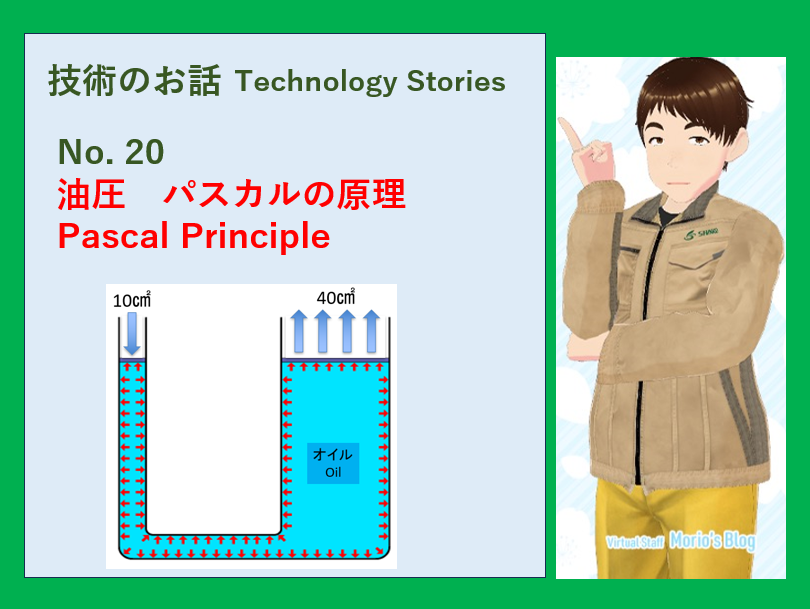
例えば、液体が入った閉じられた容器を想像してみてください。この容器には2つの口があり、入口側が小さく、出口側が大きくなっています。
エントリー側を押す
小さい方のエントリーにポンプがついて、これをギュッと押すとどうなりますか?小さなシリンダーに圧力がかかり、液体(オイル)が動きます。このとき、液体の特性である「非圧縮性」により、押した力がそのまま液体全体に伝わります。
出口側に力が伝わる
入口側の圧力は出口側の大きなシリンダーにも均等に渡ります。面積が倍なら、圧力も倍となって働きます!つまり、小さな力を大きな力に「倍増」できるんです。
パスカルの原理を公式にしてみると、
力(F) = 圧力(P) × 面積(A)
ただ、押す量は、面積に反比例します。小さい方はたくさん押さないとダメということです。
そう言えば、ジャッキのレバーを何回も上げ下げして、重い物を少しずつ持ち上げてますもんね。
では、また次回を楽しみにしていてくださいね。
※本ブログは、ベース文章から生成AIで作成しています。
No.20 Hydraulic (oil) 2 Pascal Principle
Hi, it’s Morio!
Welcome to the second installment of my hydraulic series. This time, I’ll talk about the very foundation of hydraulics: Pascal’s Principle!
Do you remember learning about this in middle school science? Re-visiting this principle as an adult makes me think, “Wait a minute, isn’t this kind of amazing?”
“The pressure applied to a confined liquid is transmitted equally in all directions, regardless of the shape of the container.”
If this explanation feels a little abstract, let’s dive into an example to make it easier to understand.
Imagine a Closed Container Filled with Liquid
Picture a sealed container filled with liquid that has two openings. The inlet side is small, while the outlet side is larger.
Applying Force on the Inlet
When you push down on a pump connected to the small inlet, what happens? Pressure is applied to the small cylinder, forcing the liquid (oil, in this case) to move. Thanks to the liquid’s unique property of being incompressible, the force you applied gets transmitted throughout the liquid uniformly.
Force is Transmitted to the Outlet
The pressure applied at the small inlet reaches the larger cylinder on the outlet side evenly. Now, here’s the fascinating part: if the area of the outlet is larger than the inlet—let’s say 10 times larger—the same pressure results in 10 times more force at the outlet! In essence, you can amplify a small force into a much greater one.
In formula terms, Pascal’s Principle can be expressed as:
Force (F) = Pressure (P) × Area (A)
However, there’s a catch: the distance you need to push is inversely proportional to the area. So, if you’re working with a smaller inlet, you’ll have to pump it a lot more. That’s why, for example, when using a jack, you need to pump the lever up and down several times to lift something heavy, little by little.
Stay tuned for the next post, where I’ll dive even deeper into the wonders of hydraulics. See you next time!
#This blog is made by generative AI from original text.