










その10:送り軸の浸炭焼入れ
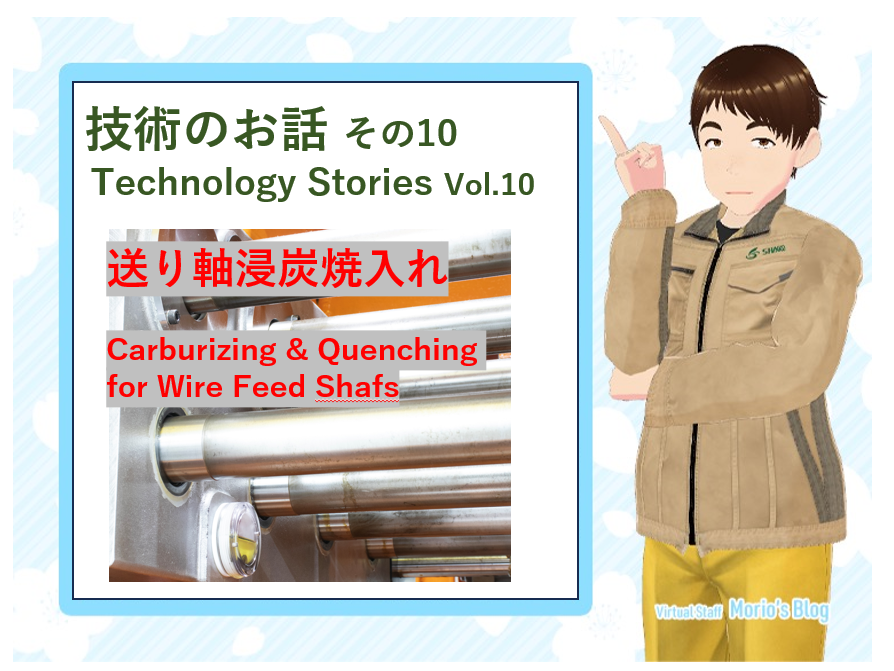
こんにちは、もりおです!春も深まり、新緑がまぶしい季節です。今日は、送り軸について、浸炭焼入れを施すメリットについてお話しします。
ばね加工機のワイヤー送り軸は、高速回転に加え、加速・減速・停止を繰り返し、また前回までに説明したように、ベアリングとの組み合わせで使用されることから、硬さ、耐久性、ねじれ応力への対応(靱性)、つまり、「外は硬いが、中は粘りがある」を求められます。そんな中、ぼくたちの会社では、SPC50を含むほとんど全ての商品で、送り軸にクロムモリブデン鋼に浸炭焼入れ処理を行っているんです。
浸炭焼入れとは?
これは、鋼部品を炭素含有の環境(通常はガスやソルトバス)で長時間加熱し、表面に炭素を浸透させた後に急冷して表層部分を硬化させる方法です。長時間ってところがポイントですね。長時間、部品全体への過熱を行うため、後述する高周波焼入れに比べ、寸法変化が起きやすいデメリットはあるのですが、そこは熱処理の技術としっかり検査でカバーです。大事なところは、手間より品質、当社の持ち味です。この処理により、表面は非常に硬くなりますが、内部は靭性を保つことができるんです。具体的には、クロムモリブデン鋼の場合、表面硬度はHV700から1000(HRC60から70)、内部硬度はHV200から400(HRC20から40)となります。クロムモリブデン鋼は、浸炭焼入れ処理を行うことで、硬度、靱性、耐久性、耐摩耗性といった特長を発揮できる材料です。うちの会社では、浸炭硬化層の厚さもしっかり指定して、加工をお願いしていますよ。
※HV:ビッカース硬さ。HRC:ロックウェル硬さ。測定方法の違いから、対象への適性が異なります。詳細な説明は省略しますが、「数値が高いほど硬い」とお考え下さいね。
高周波焼入れ
高周波焼入れという方法もあります。これは、交流の高周波電流を金属部品に流し、電流によって生じるジュール熱で表面を局部的に急速に加熱し、その後急冷する方法です。この技術は、短時間で局部的な硬化に特化しています。硬度は、クロムモリブデン鋼の場合、表面がHV550から750(HRC50から58)、内部がHV200から400(HRC20から40)です。
送り軸に浸炭焼入れを採用するメリット
1.耐摩耗性の向上: 表面がしっかり硬化されていますので、摩耗を効果的に防ぎます。
2.疲労強度の向上: 硬化層により、反復負荷による疲労破壊のリスクが低減します。
3.靭性の維持: 高速かつ、速度変化が激しく頻繁な送り軸の、ねじれ応力への耐性が増しますので、破損が少なくなります。
4.全体的な硬化: 浸炭焼入れにより送り軸全体が均一に硬化され、高周波焼入れでは難しい全体の均一性が保たれます。
5.長期的な耐久性: これらの結果、長時間の過酷な運用にも耐える耐久性を実現します。
クロムモリブデン鋼と浸炭焼入れの組合せのすばらしさ、わかって頂けましたか?送りは、ばね加工の精度に大きく関係する機能です。単発的な精度だけではなく、経年的な劣化破損や送り軸の位置ずれのような現象を防ぐためにも、拘りたい部分ですね。
Vol10: Carburizing & Quenching for Wire Feed Shafts
Hi, this is Morio! As spring season deepens, the fresh greenery is dazzling. Today, I’d like to talk about the benefits of Carburizing & Quenching the feed shafts used in our products.
Wire feed shafts in spring machines not only rotate at high speeds but also frequently accelerate, decelerate, and stop. As I’ve explained before, they are used with bearings, demanding hardness, durability, and toughness to withstand torsional stress. This means they need to be “hard on the outside but tough on the inside.” At our company, we apply Carburizing & Quenching to the chrome-molybdenum steel of the feed shafts in almost all of our products, including SPC50.
What is Carburizing & Quenching?
This process involves heating steel parts in a carbon-containing environment (usually gas or salt baths) for an extended period, allowing carbon to penetrate the surface, followed by rapid cooling to harden the outer layer. “Long time heating” is crucial here. Although this can lead to dimensional changes, a disadvantage compared to induction hardening mentioned later, we manage it with our great suppliers’ precise heat treatment techniques and thorough inspections. What’s important is prioritizing quality over efficiency, a feature of our company’s approach. This treatment not only significantly hardens the surface but also maintains toughness inside. For chrome-molybdenum steel, the surface hardness reaches HV700 to 1000 (HRC60 to 70), while the core remains at HV200 to 400 (HRC20 to 40). Chrome-molybdenum steel showcases its best features of hardness, toughness, durability, and wear resistance with Carburizing & Quenching.
Induction Hardening
Another method is induction hardening, which involves passing high-frequency alternating current through metal parts. This current generates Joule heat, rapidly heating the surface locally, followed by rapid cooling. This technique is specialized for quickly hardening specific areas. For chrome-molybdenum steel, the surface reaches a hardness of HV550 to 750 (HRC50 to 58), with the core at HV200 to 400 (HRC20 to 40).
Benefits of Carburizing the Feed Shaft
1. Improved Wear Resistance: The thoroughly hardened surface effectively prevents wear.
2.Enhanced Fatigue Strength: The hardened layer reduces the risk of fatigue failure from repetitive loads.
3.Maintained Toughness: Enhances resistance to torsional stress in the feed shafts that operate at high speeds with frequent speed changes, reducing the likelihood of damage.
4.Uniform Hardening: Carburizing & Quenching ensures uniform hardening throughout the shaft, a consistency that’s challenging to achieve with induction hardening.
5.Long-Term Durability: These benefits contribute to the shaft’s ability to withstand long periods of rigorous operation.
I hope you now understand the excellent combination of chrome-molybdenum steel and Carburizing & Quenching. Wire feeding is a crucial function related to the precision of spring processing. It’s not just about one-time accuracy but also about preventing long-term degradation, damage, or misalignment of the feed shafts. It’s an aspect we’re particularly meticulous about.