











その9 SPC50送り円錐ころ軸受
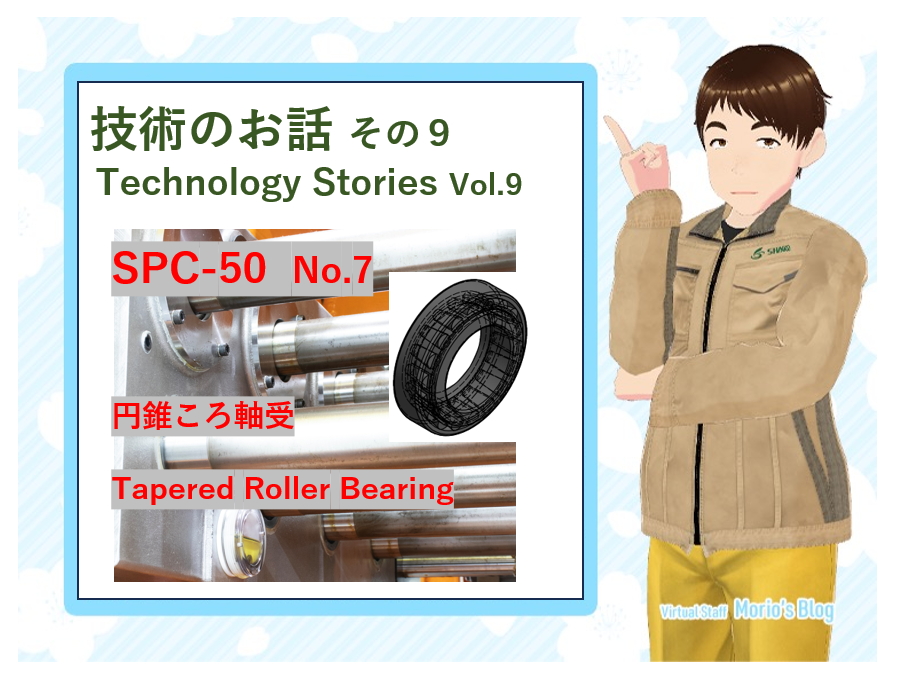
こんにちは、もりおです。前回はSPC50の送り軸後方に使われているアンギュラ玉軸受についてお話ししましたが、今回は前方の円錐ころ軸受に焦点を当ててみたいと思います。
円錐ころ軸受とは、その名が示す通り、ころが円錐形をしている軸受のことです。この形状がもたらす2つの大きな特長、高負荷能力と軸方向の荷重への強さを持ちます。円錐形のころは、点接触ではなく線接触を実現することで、より大きな荷重を支えることが可能です。また、ころと軌道の接触角が軸方向を向いているため、軸方向の荷重にも強く、高い剛性と送り精度の向上に貢献しています。SPC50では、この円錐ころ軸受を軸後方のアンギュラ玉軸受と同じく、逆向きに2つ使用することで耐荷重性を高めています。
しかし、この軸受は取り扱いが難しい部分もあります。高い負荷と大きな接触面積による摩擦や熱の発生を抑えるため、部品の精度や組み付けが非常に重要になります。特に、「与圧」という工程が重要です。与圧とは、軸受の内部に意図的に加える荷重のことで、ころが内輪と外輪に特定の力で押し付けられることによって適用されます。これにより、軸受内の部品が適切に接触し、振動やノイズの低減、安定した運転と耐久性の向上が期待されます。
また、「間座」という部品も重要です。間座は、与圧を部品の厚みで設計するためのスペーサのようなもので、ころ同士の摩耗や損傷を防ぎながら、荷重を均等に分散させて、耐荷重性を高める役割を担っています。
与圧の管理は、軸受ころの角度をどう狙うかによっても変わってきます。当社では、軸受の組み付けにおいて以下のような対策を講じています。
1.軸受や関連する部品に摩耗や損傷がないかを確認します。摩耗や損傷がある場合、軸受の性能に影響を与え、早期の故障を引き起こす可能性があります。
2.取付け前には、すべての部品の寸法を慎重にチェックし、対応する軸やハウジングとの間の適切なクリアランスが保たれることを確認します。
3.圧入ツールなどの専用ツールを使って、内輪や外輪を均等に緩めて拡大させ、はめ込む技術が必要になります。加熱装置を使用する、いわゆる「焼き嵌め」が行われる場合もありますが、当社では、熱膨張による悪影響を避けるために行っていません。
4.当社では、組立性、メンテナンス性、必要精度、剛性など複合的に検討した寸法公差を採用し、組込み調整を行っています。
5.取付け完了後には、軸受の回転テストを実施して、起動トルク及び変位量の測定も行います。異常音や振動の有無も確認し、必要に応じて調整を行います。
6.適切な与圧の調整には、専門的なスキルや計測ツールも必要です。
技術は常に進化していますが、細かい部分の精密な作業が全体の性能を左右します。このようなスキルや知識を深めることで、私たちはより良い製品を提供できるように努めています。今回の調査も非常に勉強になりましたし、これからもこのような技術的な深掘りを続けていきたいと思います。次回もお楽しみに!
※本文は、ベース文章から、生成AIを使って作成しています。
Vol.9 Tapered Roller Bearng for SPC-50 Feeding Unit
Hi, Morio has come back. Last time, we discussed the angular contact ball bearings used in the rear of the SPC50’s feed shaft, but this time, I’d like to focus on the tapered roller bearings used at the front.
Tapered roller bearings, as their name suggests, have rollers that are shaped like cones. This design offers two significant advantages: high load capacity and robustness against axial loads. The conical shape of the rollers allows for line contact rather than point contact, which enables them to support greater loads. Moreover, the angle of contact between the rollers and the tracks is oriented axially, enhancing the bearing’s ability to withstand axial loads and contributing to higher rigidity and improved feed accuracy. In the SPC50, we use two tapered roller bearings in reverse orientation, similar to the angular contact ball bearings at the rear, to enhance load resistance.
However, these bearings can be challenging to handle due to the high load and large contact area which can lead to friction and heat generation during operation. Therefore, precision in component machining and assembly is crucial. A particularly important process in this regard is “Preloading.” Preloading refers to the intentional load applied within the bearing, which presses the rollers between the inner and outer rings, ensuring proper contact within the bearing. This helps reduce vibration and noise, stabilizes operation, and improves durability.
Another critical component is the “spacer,” which is designed to manage preload by adjusting the thickness of parts within the bearing. It helps prevent wear and damage between rollers and evenly distributes the load, enhancing the bearing’s ability to handle stress.
The management of preload varies depending on how the bearing’s roller angles are targeted. At our company, we take the following measures in assembling bearings:
- We check for wear and damage on the bearings and related components. If any wear or damage is found, it can affect the performance of the bearing and potentially lead to premature failure.
- Before installation, we carefully check the dimensions of all parts to ensure that the proper clearances are maintained between the shaft and housing.
- We use specialized tools, such as press-fitting tools, to evenly loosen and expand the inner and outer rings for proper fitting. Although “shrink fitting” with heating devices is sometimes used, our company avoids this to prevent adverse effects due to thermal expansion.
- We adopt dimensional tolerances that consider assembly, maintenance, required precision, and rigidity, and adjust the assembly accordingly.
- After installation, we perform a rotation test on the bearing to measure startup torque and displacement. We also check for any unusual sounds or vibrations and make adjustments as necessary.
- Proper adjustment of preload requires specialized skills and measurement tools.
Technology continually evolves, but the precise work on small details can significantly impact the overall performance. By deepening our skills and knowledge in these areas, we strive to provide better products. This investigation has been very enlightening, and I look forward to continuing to delve into these technical aspects in future posts. Stay tuned for more!
#This blog is made by generative AI from original text.