








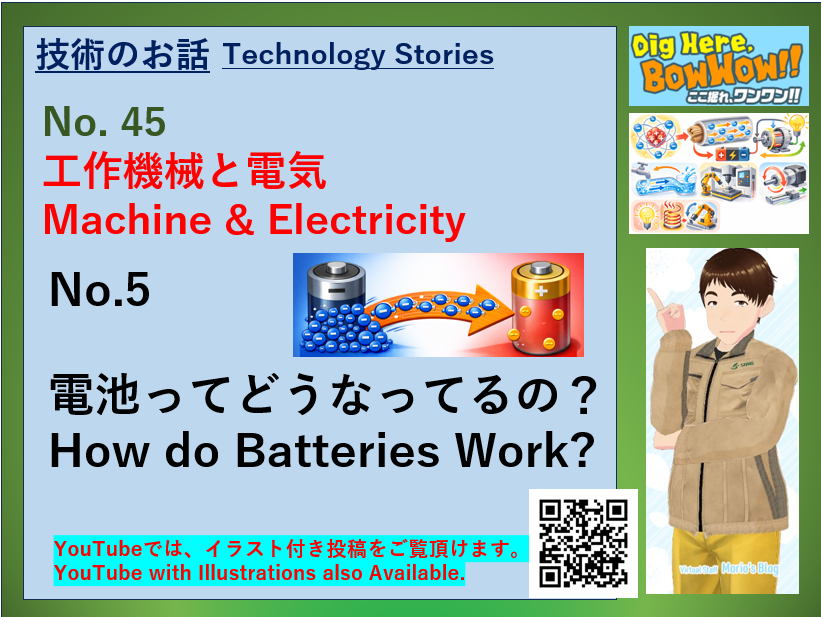
工作機械と電気 No.5 電池ってどうなってるの?
わかば:
やっほー!今回のテーマは電池だね!
身近な例で、乾電池で説明してよ。
もりお:
OK。一般的なマンガン乾電池で説明しよう。
電池は、「中の材料どうしの反応で電子を動かすしくみ」なんだ。
わかば:
でもさ、物ってもともと陽子と電子の数はつり合ってるでしょ?
なのに、なんで電子が動くの?
もりお:
物質によって、「電子をどれくらいつなぎ止めやすいか」が違うんだ。
わかば:
えっ?
それがプラス極とマイナス極につながるの?
もりお:
その通り。
「電子を出しやすい側がマイナス極」、「電子を受け取りやすい側がプラス極」になる。
マンガン乾電池だと、マイナス極側で亜鉛、プラス極側で二酸化マンガンが使われてる。
わかば:
じゃあ、電子を出す主役は亜鉛なんだ。
ばね材のメッキに使われているだけじゃないんだね。
もりお:
亜鉛は電池の中で、「亜鉛イオンに変わる反応」をするんだ。
そのときに電子を出す。
イメージはこんな感じ。
亜鉛 → 亜鉛イオン + 電子
わかば:
へえー。
亜鉛が変わるときに電子が出るだ。
もりお:
そういうこと。
でも、亜鉛が何もないのに勝手に電子をポロッと出してるわけじゃないんだ。
そこで出てくるのが「電解液」なんだ。
わかば:
電解液?
もりお:
電池の中で反応が進むのを助ける、中の液体やペーストだよ。
マンガン乾電池では、塩化アンモニウムや塩化亜鉛みたいな成分が入っていて、
しみこんだペーストみたいになってることが多いんだ。
「反応が進みやすい環境を作る役」だね。
逆にいうと、
亜鉛は電解液の中の水分やイオンに囲まれた環境の中で反応して、亜鉛イオンになっていくんだ。
わかば:
そっか、マイナス極側では、
亜鉛が反応して、亜鉛イオンができると
電子を外に出せる状態になるんだね。
じゃあ、逆にプラス極側はどうなってんの?
もりお:
プラス極側では、二酸化マンガンが
その電子を受け取る反応を進める。
ここでも電解液の成分が働いて、全体の流れを支える。
わかば:
そっか。
ここに電線や豆電球をつなぐと、電子が外の回路を流れて、電気が使えるってわけだ。
でも、電池って切れるのはなぜ?
もりお:
いい質問。
電池の中で反応を繰り返しているうちに、
電子を出しやすかった物質や、受け取りやすかった物質が少しずつ変わっていく。
すると最初みたいな差が作れなくなる。
わかば:
差っていうのは、
「こっちは出しやすい」「こっちは受け取りやすい」って差?
もりお:
そう。
その差が小さくなると、電子を押し出す力もだんだん弱くなる。
だから電灯が暗くなったり、動きが弱くなったりして、最後は電池切れになるんだ。
わかば:
いいね、わかってきた!
最後にまとめてみて!
もりお:
箇条書きにしてみるね。
・物質には、電子を手放しやすい物質と受け取りやすい物質がある
・その性質を組み合わせて、電池が作られる
・マンガン乾電池の場合、マイナス極側では亜鉛が、プラス極側では二酸化マンガンが使われる
・亜鉛が、亜鉛イオンと電子になるのに、電解液の環境が大きな役割を果たしている
・反応が続いて、マイナス極とプラス極の差が小さくなると、電子の流れが弱まって、電池が切れる
わかば:
おおー、スッキリ!
でも、うちらの機械って、電池もあるけど、
電源からケーブルが大元だよね。
もりお:
そうだね。次回は、「電源」について深掘りしてみよう。
※本ブログは、生成AIを活用して作成しています。
Machine & Electricity No.5 How do Batteries Work?
Wakaba:
Ciao! This time, the theme is batteries, right?
Explain it using a familiar example—like a dry cell battery.
Morio:
OK. Let’s use a typical manganese dry cell battery as an example.
A battery is “a mechanism that moves electrons through reactions between the materials inside it.”
Wakaba:
But wait, aren’t the numbers of protons and electrons in a material normally balanced to begin with?
So why do electrons move?
Morio:
Because different materials differ in **how tightly they hold onto electrons**.
Wakaba:
Huh?
And that leads to the positive and negative terminals?
Morio:
Exactly.
The side that gives up electrons more easily becomes the **negative terminal**, and the side that receives electrons more easily becomes the **positive terminal**.
In a manganese dry cell battery, **zinc** is used on the negative side, and **manganese dioxide** is used on the positive side.
Wakaba:
So zinc is the main player that releases electrons.
It’s not just something used for plating spring materials, then.
Morio:
Right. Inside the battery, zinc undergoes **a reaction that turns it into zinc ions**.
When that happens, it releases electrons.
The image looks like this:
**Zinc → Zinc ion + Electron**
Wakaba:
Wow.
So when zinc changes, electrons come out.
Morio:
That’s right.
But it’s not like zinc just casually drops electrons all by itself for no reason.
That’s where the **electrolyte** comes in.
Wakaba:
The electrolyte?
Morio:
It’s the liquid or paste inside the battery that helps the reaction proceed.
In a manganese dry cell battery, it often contains ingredients like **ammonium chloride** and **zinc chloride**,
and it’s often in a paste-like form soaked into the inside.
Its role is to **create an environment where the reaction can happen easily**.
In other words,
zinc reacts while surrounded by moisture and ions in the electrolyte, and that is how it turns into zinc ions.
Wakaba:
I see. So on the negative-terminal side,
when zinc reacts and zinc ions are formed,
it reaches a state where it can release electrons to the outside.
So then, what’s happening on the positive-terminal side?
Morio:
On the positive-terminal side, **manganese dioxide** promotes the reaction that receives those electrons.
Here too, the components of the electrolyte are at work, supporting the overall flow.
Wakaba:
Got it.
So if you connect a wire or a small bulb here, electrons flow through the outside circuit, and that’s how electricity can be used.
But why does a battery run out?
Morio:
Good question.
As the reactions keep repeating inside the battery,
the materials that were good at releasing electrons and the materials that were good at receiving them gradually change.
As a result, the difference between them becomes smaller, and the battery can no longer create the same kind of gap it had at the beginning.
Wakaba:
By “difference,” you mean
the difference between “this side gives up electrons easily” and “this side receives electrons easily”?
Morio:
Exactly.
When that difference gets smaller, the force pushing electrons along also gets weaker.
That’s why a light gets dimmer, or motion becomes weaker, and in the end the battery goes dead.
Wakaba:
Nice, I’m getting it now!
Can you sum it up at the end?
Morio:
Sure. Let me put it in bullet points.
* Some materials give up electrons easily, while others receive electrons easily
* Batteries are made by combining those different materials
* In a manganese dry cell battery, zinc is used on the negative-terminal side, and manganese dioxide is used on the positive-terminal side
* The electrolyte environment plays a major role in enabling zinc to become zinc ions and release electrons
* As the reaction continues, the difference between the negative and positive sides gets smaller, the flow of electrons weakens, and the battery runs out
Wakaba:
Ohhh, that makes it really clear!
But our machines do have batteries sometimes—still,
their main power source is really the cable from the power supply, right?
Morio:
That’s right. Next time, let’s take a deeper look at **power supplies**.
Note: This blog was created with the hepl of generative AI.