




その4 SPC50開発 その2 送り機構1

あっ、こんにちは、もりおです。今日はSPC50の2回目です。
コイリングマシンの心臓部とも言える「送り機構」について、その精度と高速性の重要性に焦点を当てたいと思います。
SPC-50の開発においては、ワイヤーをどのようにして正確に、かつ迅速に加工部まで送り出すかが重要テーマでした。
押ばねの製造工程は基本的に、ワイヤーを送りながら、曲ダイスに当てることでコイリング加工を行い、切断するという2つのステップです。
トーションばねと比べて、1度に送るワイヤーの量が多くなるため、高速かつ正確な長さでワイヤーを送ることが非常に重要です。
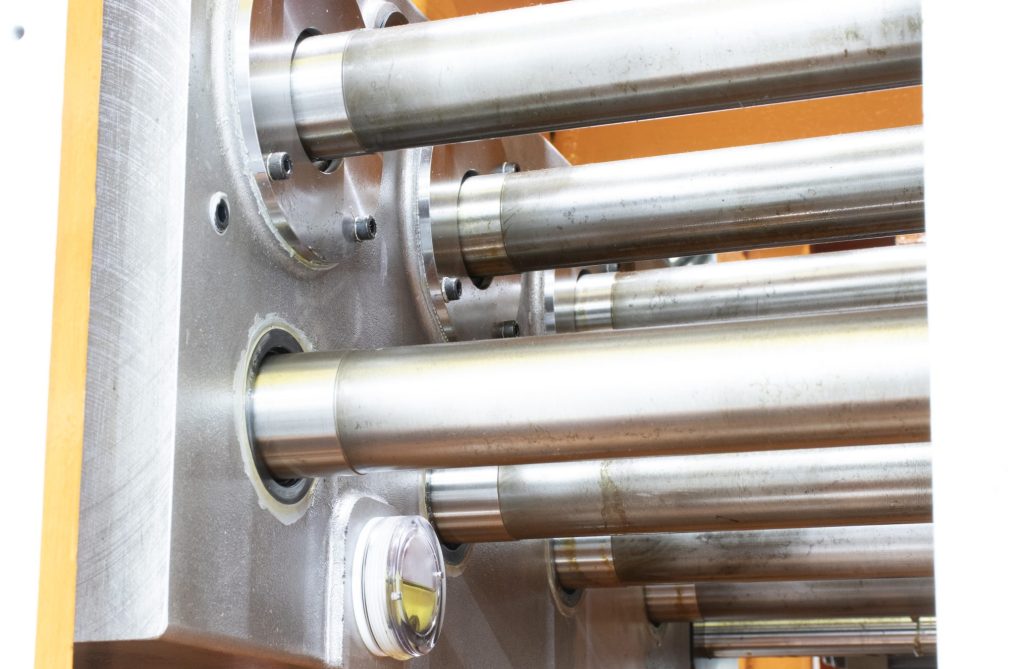
まず、「正確に送る」を取り上げます。ワイヤーは、上下2つ(1連)の送りローラに挟まれ、加工部まで送り出されます。機械構造的には、モーターの回転が減速機(※1)で適切な速度・トルク(※2)に変換され、片方の送り軸(シャフト)及び送りローラに、さらに歯車(ギヤ(※3))を介して、もう片方の送り軸(シャフト)及び送りローラに回転が伝わります。SPC-50の大きな特長は、1つのモーターを使って1連(上下2個)の送り軸・送りローラを駆動させている点です。
通常のコイリングマシンでは、1つのモーターで、2連以上(4個以上)の送り軸・送りローラを回転させます。複数の送りローラを回転させるためには、それだけの数の歯車(ギヤ)が必要ですが、歯車(ギヤ)にはバックラッシ(※4)があり、個数が多いほど、送り精度の低下につながります。また、経年劣化により、ガタ(※5)が生じる可能性もあります。
SPC-50では、この問題に対処するため、1つのモーター・減速機で1連(2個)の送り軸・送りローラを動かす設計を採用しています。これにより、歯車(ギヤ)の個数を減らし、モーターの回転精度を落とさずに、送りローラに伝えることができ、高精度な送りが可能になるわけです。
用語説明
・減速機(※1):、モーターの高速回転を減速させて、必要な速度やトルクを実現させる機構
・トルク(※2):固定された回転軸に対して、物体が回転時にはたらく力
・ギヤ(※3):ギアとも言いますが。JISでは、「ギヤ」になっています
・バックラッシ(※4):バックラッシュとも。ギヤなどの機械的な遊びのことで、精度に直接影響します。
・ガタ(※5):部品の緩みや摩耗による不必要な動きのことで、これも精度の敵ですね。
※本文は、ベース文章から、生成AIを使って作成しています。
Vol. 4 Development of SPC-50 Vol.2 Wire Feeding Structure 1
Hi, I’m Morio. Today, we dive into the second session of the SPC50. I’d like to focus on the “Wire feed mechanism,” the heart of our coiling machine, and discuss the critical importance of its precision and speed. In the development of the SPC-50, a major theme was how to accurately and fast feed wire to the processing area.
The basic process of making springs involves feeding wire while coiling it against coiling points, followed by cutting it.
Reference: Development Concept No.1 Mechanical elements to make springs
Compared to torsion springs, the amount of wire fed at once is significantly larger, making it crucial to feed the wire both quickly and with precise length.
First, let’s talk about “accurate feeding.” Wire is fed to the processing area by being clamped between two (one pair of) feed rollers. From a mechanical structure perspective, the motor’s rotation is converted into the appropriate speed and torque by a reducer (※1), which then drives one feed shaft (and roller) and, through gears, transfers rotation to the other feed shaft (and roller). A significant feature of the SPC-50 is its design that allows a single motor to drive a pair (two) of feed shafts and rollers. Typically, coiling machines use one motor to rotate two or more pairs (four or more) of feed shafts and rollers. Rotating multiple feed rollers requires multiple gears, but gears have backlash (※3), so the more gears are used, the worse feeding precision gets. Additionally, long-time use can cause play (※4), potentially affecting precision.
To address this issue, the SPC-50 adopts a design that uses one motor and reducer to rotate a pair (two) of feed shafts and rollers. This reduces the number of gears needed, allowing the motor’s rotational precision to be directly transferred to the feed rollers, enabling precise feeding.
Termsy:
- Reducer (※1): A mechanism that slows down the high-speed rotation of a motor to achieve the necessary speed and torque.
- Torque (※2): The force that acts on a fixed rotational axis when an object rotates.
- Backlash (※3): The mechanical play in gears, directly affecting precision.
- Play (※4): Unnecessary movement due to parts loosening or wearing out, also an enemy of precision.
#This blog is made by generative AI from original text.