






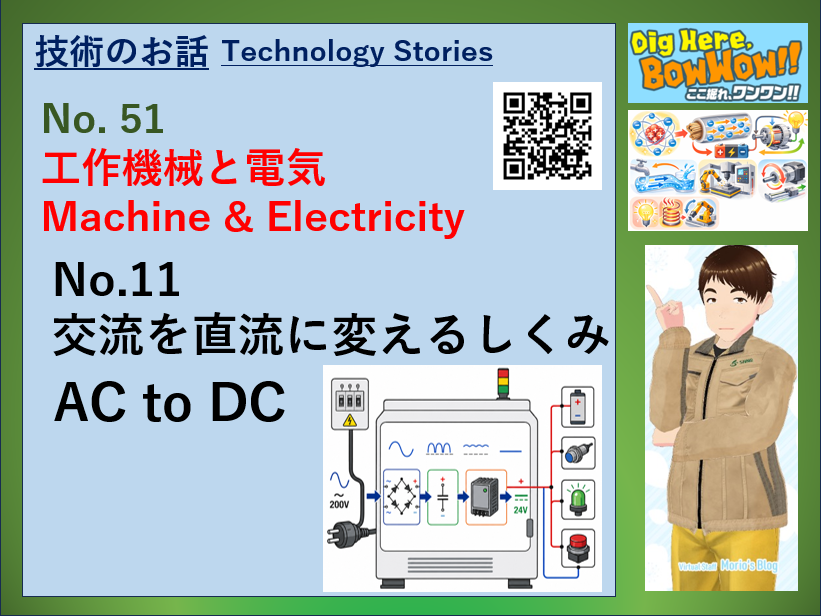
工作機械と電気 No.11 交流を直流に変えるしくみ
わかば:
やっほー!わかばだよ!
今回は、交流を直流に変えるしくみ!
もりお:
前回は、交流は波のように変化していて、電圧を変えやすいから送電に向いている、って話をしたよね。
わかば:
うん。
発電所から工場まで、交流で電気が届くんだったよね。
もりお:
そうそう。
そして、工場の工作機械には、交流200Vが入ってくることが多い。
工作機械は、まずこの交流の電気を受け取って動いているんだ。
わかば:
交流200V!
家庭のコンセントより強そう。
もりお:
そうだね。
家庭では100Vが身近だけど、工場の機械では交流200Vを使うことが多い。
モーターを動かしたり、機械全体に電気を送ったりするために必要なんだ。
わかば:
でも、機械全部が交流200Vで動いてるわけじゃなかったよね?
もりお:
そこがポイント。
工作機械の中では、交流200Vをそのまま使う場所もあるけど、直流に変えて使うところも多いんだ。
わかば:
交流を直流?あっ、今回のテーマだ!
もりお:
交流を直流に変えることを、「整流」っていうんだ。
わかば:
せいりゅう?
なんか、流れを整えるって感じ?
もりお:
まさにそのイメージ。
交流は、電気の向きが行ったり来たりしている。
それを、片方の向きにそろえてあげる。
これが整流だよ。
わかば:
なるほど。
行ったり来たりしている電気を、一方通行っぽくするんだ。
もりお:
そう。
ここで活躍する代表的な部品が、ダイオード。
わかば:
ダイオード?
また新しい言葉!
それって半導体と同じもの?
もりお:
いい質問。
ダイオードは、半導体を使った部品の一つだよ。
つまり、半導体とまったく別物というより、半導体の性質を利用した電子部品なんだ。
わかば:
半導体を使った部品なんだ。
基本的なこと聞くけど、半導体って何?
もりお:
ざっくり言うと、半導体は、条件によって電気の通し方をコントロールできる材料。
ダイオードはその性質を利用して、電気を一方向にだけ通しやすくしている。
わかば:
一方向にだけ通しやすい?
つまり、電気の一方通行ゲート?
もりお:
その通り。
ダイオードは、電気の逆流を止める一方通行のゲートみたいなものだね。
わかば:
何だかイメージ湧いてきた。
もりお:
交流は、右へ押したり、左へ押したりする電気だったよね。
そこにダイオードを使うと、通していい向きの電気だけを通して、反対向きは止めることができる。
わかば:
じゃあ、半分だけ使う感じ?
もりお:
すごくざっくり言うと、そういう方法もある。
でも実際には、複数のダイオードを組み合わせて、交流の反対向きの部分もひっくり返して使うことが多い。
わかば:
反対向きの部分を、ひっくり返す?
もりお:
そう。
交流の波は、プラス側に行ったり、マイナス側に行ったりする。
そのマイナス側に行く部分を、回路の工夫でプラス側に向け直す。
すると、全部が同じ方向に流れるように見えるんだ。
わかば:
へぇー!
反対に行こうとする波を、こっち向きにそろえるんだね。
もりお:
そういうこと。
これで、交流が直流に近い形になる。
わかば:
でもさ、波をひっくり返しただけだと、まだデコボコしてない?
完全にまっすぐな直流には見えない気がする。
もりお:
最近鋭くなってきたね。
整流した直後の電気は、まだ波のデコボコが残っているんだ。
わかば:
やっぱり!
もりお:
そこで、次に「平滑」という考え方が出てくる。
わかば:
へいかつ?
平らでなめらかにするってこと?
もりお:
そうそう。
整流で向きをそろえたあと、デコボコをできるだけなめらかにする。
この役割でよく使われるのが、コンデンサという部品だよ。
わかば:
コンデンサ?
もりお:
電気を一時的にためたり、出したりできる部品。
水でいうと、小さなタンクみたいなイメージかな。
わかば:
タンク?
もりお:
そう。
水の流れが強いときに少しためて、弱くなったときに出してあげる。
そうすると、水の流れがなめらかになるでしょ。
わかば:
あー、なるほど!
電気のデコボコをならしてくれるんだ。
もりお:
整流で向きをそろえて、平滑でデコボコをならす。
この流れで、交流から直流を作っていくんだ。
わかば:
交流を直流に変えるって、
「向きをそろえる」
「デコボコをならす」
この2段階ってこと?
もりお:
そんな感じ。
実際の電源回路はもっと複雑だけど、まずはそのイメージでOK。
わかば:
でも、交流200Vを24V直流に変えるって、電圧も変えてるし、交流から直流にも変えてるんだよね。
それって、変圧器でやってるの?
もりお:
いい質問。
変圧器は、交流の電圧を上げたり下げたりする装置。
たとえば、交流200Vを別の交流電圧に変えるようなイメージだね。
わかば:
じゃあ、交流を直流に変えるのは別なの?
もりお:
そう、ちょっとややこしい。
交流を直流に変えたり、直流の電圧を安定させたりするところでは、コンバーターや電源ユニットが活躍する。
わかば:
コンバーター?
それも変換する装置ってこと?
もりお:
そうそう。
ざっくり言うと、コンバーターは電気を機械の中で使いやすい形に変える変換係だね。
交流を直流に変えたり、電圧を調整したりする役割がある。
わかば:
変圧器は、交流の電圧を変える係。
コンバーターは、電気の形や電圧を使いやすく変える係。
そんな感じ?
もりお:
かなりいいね。
実際の電源ユニットの中では、整流したり、平滑したり、必要な電圧に調整したりしている。
その結果、交流200Vから24V直流のような制御用の電気が作られるんだ。
わかば:
なるほど。
交流200Vを、機械の中で使いやすい24V直流に変えるんだ。
けっこう大変な変身だね。
もりお:
そうだね。
電源ユニットやコンバーターは、機械の中の変身係みたいなもの。
外から来た交流を、機械の中で使いやすい直流に変身させる。
だから、制御の安定にはとても大事な部品だよ。
わかば:
工作機械の中では、どこで24V直流を使ってるんだっけ?
もりお:
たとえば、制御装置、センサー、ランプ、リレー、ボタンまわり。
こういうところでは、24V直流がよく使われる。
わかば:
また24V出てきた!
工作機械の制御では、よく登場するね。
もりお:
そうだね。
機械の動きを判断したり、信号を受け取ったり、ランプを点けたりするところでは、安定した直流が大事なんだ。
わかば:
もし、その電源ユニットが調子悪くなったら?
もりお:
センサーの信号が不安定になったり、ランプが点かなかったり、制御装置が正常に動かなくなったりすることがある。
だから、トラブル調査では、24V直流がちゃんと出ているか確認することも大事なんだ。
わかば:
電気って見えないけど、ちゃんと確認するポイントがあるんだね。
もりお:
そう。
テスターで電圧を測ったり、ランプの点灯を見たり、制御装置の表示を確認したりする。
見えない電気を、見える情報にして確認するのが大事なんだ。
わかば:
なるほど。
交流から直流に変える話って、ただの理科の話じゃなくて、機械のトラブル対応にも関係あるんだね。
もりお:
その通り。
工作機械は、交流200Vで大きな力を受け取り、必要なところで直流に変えて、細かい制御をしている。
この変換がうまくいくから、センサーも制御も安定して働けるんだ。
わかば:
今日のまとめ、いってみよ!
もりお:
工作機械には、交流200Vが入ってくることが多い。
でも機械の中では、交流を直流に変えて使うところも多い。
交流を直流に変えることを「整流」という。
整流では、行ったり来たりする交流の向きを、一方通行にそろえる。
その代表的な部品が、半導体部品の一つであるダイオード。
整流した直後の電気にはデコボコが残る。
そのデコボコをコンデンサなどでなめらかにすることを「平滑」という。
変圧器は、交流の電圧を上げたり下げたりする装置。
コンバーターや電源ユニットは、電気の形や電圧を機械の中で使いやすく変える変換係。
工作機械の中では、電源ユニットやコンバーターが交流200Vを24V直流などに変え、制御装置やセンサーを動かしている。
わかば:
よし、わかった!
外から来るのは交流200V。
それを機械の中で使いやすい直流に変える。
そのために、ダイオードやコンデンサ、コンバーターが働いているんだね。
もりお:
そうそう。
次回は、工作機械の中でよく使われる24V直流について、もう少し見ていこう。
センサーやボタン、ランプとの関係が見えてくるよ。
わかば:
なんだか工作機械の中の電気が、だんだん見えてきた!
また次回も頑張って行こう!
※本ブログは生成AIを活用して作成しています。
Machine & Electricity No. 11 AC to DC
Wakaba:
Ciao! It’s Wakaba!
Today, we’re talking about how AC is converted into DC!
Morio:
Last time, we talked about how AC changes like a wave and is suitable for power transmission because its voltage is easy to change.
Wakaba:
Right.
Electricity reaches factories from power plants as AC, right?
Morio:
Exactly.
And in factories, Machines often receive 200 V AC.
Machine first receives this AC power and uses it to operate.
Wakaba:
200 V AC!
That sounds stronger than a home outlet.
Morio:
Yes.
At home, 100 V is familiar, but factory Machines often use 200 V AC.
It is needed to run motors and send electricity throughout the Machine.
Wakaba:
But not everything inside the Machine runs on 200 V AC, right?
Morio:
That’s the key point.
Inside Machine, some parts use 200 V AC as it is, but many parts use electricity after it is converted into DC.
Wakaba:
AC into DC?
Oh, that’s today’s theme!
Morio:
Converting AC into DC is called “rectification.”
Wakaba:
Rectification?
That sounds like straightening out the flow.
Morio:
That’s exactly the image.
AC moves back and forth in direction.
Rectification lines it up in one direction.
That is rectification.
Wakaba:
I see.
It makes electricity that moves back and forth look more like a one-way flow.
Morio:
Right.
A typical part that does this is a diode.
Wakaba:
A diode?
Another new word!
Is that the same thing as a semiconductor?
Morio:
Good question.
A diode is one type of part that uses a semiconductor.
So it is not completely separate from semiconductors.
It is an electronic component that uses semiconductor properties.
Wakaba:
So it’s a part that uses a semiconductor.
Let me ask a basic question: what is a semiconductor?
Morio:
Simply put, a semiconductor is a material that can control how electricity passes through it depending on conditions.
A diode uses that property to make electricity pass more easily in only one direction.
Wakaba:
Only one direction?
So it’s like a one-way gate for electricity?
Morio:
Exactly.
A diode is like a one-way gate that stops electricity from flowing backward.
Wakaba:
Now I’m starting to picture it.
Morio:
AC is electricity that pushes to the right, then to the left, right?
If we use a diode, it can let electricity pass in the allowed direction and stop it in the opposite direction.
Wakaba:
So it only uses half of it?
Morio:
Very roughly, there is a method like that.
But in practice, multiple diodes are often combined so that the part of AC going in the opposite direction is flipped and used too.
Wakaba:
The opposite-direction part is flipped?
Morio:
Yes.
The AC wave moves to the plus side and then to the minus side.
The part that goes to the minus side is redirected to the plus side by the circuit.
Then it looks like everything flows in the same direction.
Wakaba:
Wow!
So the wave trying to go the other way is lined up in this direction.
Morio:
Exactly.
This makes AC closer to DC.
Wakaba:
But if the wave is just flipped, isn’t it still bumpy?
It doesn’t seem like perfectly straight DC yet.
Morio:
You’re getting sharp lately.
Right after rectification, the electricity still has bumps from the wave.
Wakaba:
I knew it!
Morio:
That’s where “smoothing” comes in.
Wakaba:
Smoothing?
Like making it flat and smooth?
Morio:
Exactly.
After rectification lines up the direction, smoothing reduces the bumps as much as possible.
A part often used for this is a capacitor.
Wakaba:
A capacitor?
Morio:
It is a part that can temporarily store and release electricity.
In terms of water, it is like a small tank.
Wakaba:
A tank?
Morio:
Yes.
When the water flow is strong, it stores some.
When the flow becomes weak, it releases some.
That makes the water flow smoother, right?
Wakaba:
Oh, I get it!
It smooths out the bumps in electricity.
Morio:
First, rectification lines up the direction.
Then smoothing reduces the bumps.
That is how AC is made into DC.
Wakaba:
So converting AC into DC has two steps:
“Line up the direction”
and
“Smooth out the bumps.”
Is that right?
Morio:
That’s the basic image.
Actual power supply circuits are more complex, but this is a good starting point.
Wakaba:
But converting 200 V AC into 24 V DC means the voltage changes, and AC also becomes DC, right?
Is that done by a transformer?
Morio:
Good question.
A transformer is a device that raises or lowers AC voltage.
For example, it can change 200 V AC into another AC voltage.
Wakaba:
So changing AC into DC is different?
Morio:
Yes, it’s a little tricky.
Converters and power supply units are used to change AC into DC or to stabilize DC voltage.
Wakaba:
A converter?
That also means a device that converts electricity, right?
Morio:
Exactly.
Simply put, a converter is like a conversion worker that changes electricity into a form that is easier to use inside the Machine.
It can convert AC into DC and adjust voltage.
Wakaba:
So a transformer changes AC voltage.
A converter changes the form and voltage of electricity so it can be used more easily.
Is that the idea?
Morio:
That’s very good.
Inside an actual power supply unit, electricity is rectified, smoothed, and adjusted to the required voltage.
As a result, control power such as 24 V DC is made from 200 V AC.
Wakaba:
I see.
200 V AC is changed into 24 V DC that is easier to use inside the Machine.
That’s a pretty big transformation.
Morio:
Yes.
Power supply units and converters are like transformation workers inside the Machine.
They change the incoming AC into DC that is easier to use inside the Machine.
That makes them very important for stable control.
Wakaba:
Where is 24 V DC used inside a Machine again?
Morio:
For example, around controllers, sensors, lamps, relays, and buttons.
24 V DC is often used in those areas.
Wakaba:
There’s 24 V again!
It comes up a lot in Machine control.
Morio:
Yes.
Stable DC is important for judging Machine movement, receiving signals, and turning lamps on.
Wakaba:
What happens if the power supply unit is not working well?
Morio:
Sensor signals may become unstable, lamps may not turn on, or the controller may not operate correctly.
That’s why, when investigating trouble, it is important to check whether 24 V DC is coming out properly.
Wakaba:
Electricity is invisible, but there are points we can check.
Morio:
Exactly.
We can measure voltage with a tester, check whether lamps are on, and look at the controller display.
It is important to turn invisible electricity into visible information.
Wakaba:
I see.
Converting AC into DC is not just a science topic.
It also relates to Machine troubleshooting.
Morio:
Exactly.
A Machine receives large power as 200 V AC, then converts it into DC where needed for fine control.
Because this conversion works properly, sensors and control systems can operate stably.
Wakaba:
Let’s wrap it up!
Morio:
Machines often receive 200 V AC.
But inside the Machine, AC is often converted into DC and used.
Converting AC into DC is called rectification.
In rectification, AC that moves back and forth is lined up into a one-way direction.
A typical part for this is a diode, which is one type of semiconductor component.
Right after rectification, the electricity still has bumps.
Making those bumps smoother with parts such as capacitors is called smoothing.
A transformer is a device that raises or lowers AC voltage.
Converters and power supply units are conversion workers that change the form and voltage of electricity into something easier to use inside the Machine.
Inside a Machine, power supply units and converters change 200 V AC into 24 V DC and other voltages to operate controllers and sensors.
Wakaba:
Got it!
What comes from outside is 200 V AC.
Inside the Machine, it is changed into DC that is easier to use.
Diodes, capacitors, and converters all work for that.
Morio:
Exactly.
Next time, let’s look a little more closely at 24 V DC, which is often used inside Machines.
We’ll see how it relates to sensors, buttons, and lamps.
Wakaba:
I feel like I’m starting to see the electricity inside Machines!
Let’s keep going next time!
Note: This blog was created with the hepl of generative AI.