




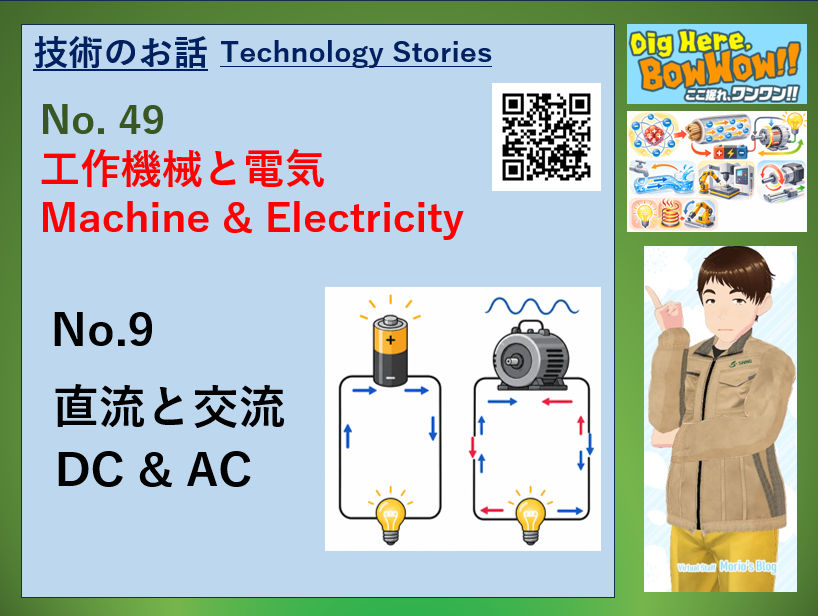
工作機械と電気 No.9 直流と交流
わかば:
やっほー!わかばだよ!
今回は、第9回:直流と交流!
もりお:
前に話した「プラスとマイナス」の話ともつながる、大事なところだよ。
わかば:
直流と交流って、よく聞くけど、結局何が違うの?
もりお:
まずは超シンプルにいこう。
直流は、電気が同じ向きに流れる。
交流は、電気の流れる向きが行ったり来たりする。
わかば:
え、交流って、電気の向きが行ったり来たりしてるの?
ずっと同じ方向に流れてるんじゃないんだ。
もりお:
そこがいちばんの違い。
直流は「一方通行」。
交流は「行ったり来たり」。
わかば:
前に、プラスとマイナスって、電子を放しやすい側と、電子を呼び込みやすい側みたいな話だったよね?
もりお:
そうそう。
すごくざっくり言うと、マイナス側は電子が多めで、電子を押し出しやすい。
プラス側は電子が足りない感じで、電子を呼び込みやすい。
その差があるから、電気が流れようとするんだ。
わかば:
それが電圧だったよね。
電気を流そうとする「押す力」。
もりお:
その通り。
電池を思い出すとわかりやすいよ。
電池は、プラス側とマイナス側が決まっている。
だから、電気を押す向きも基本的に同じ。
これが直流。
わかば:
じゃあ交流は?
「行ったり来たり」って、プラスとマイナスが入れ替わるの?
どういうしくみ?
電子を放しやすい性質と、呼び込みやすい性質が、急に変わるの?
もりお:
そこ、めっちゃ大事。
交流で入れ替わるのは、材料の性質そのものじゃないんだ。
交流で入れ替わるのは、電源が作る「電圧の向き」。
つまり、電気を押す向きが、こっち、あっち、こっち、あっち、って変わるんだ。
わかば:
電圧の向き?
もうちょいかみ砕いて!
もりお:
たとえば、発電機をイメージしてみて。
発電機の中では、磁石とコイルの関係で電気を作っている。
ぐるぐる回ることで、ある瞬間はこっち向きに電子を押す。
次の瞬間は、反対向きに電子を押す。
このくり返しで交流ができるんだ。
わかば:
なるほど。
電子を押す向きが、発電機の回転で変わるんだ。
もりお:
そう。
だから、コンセントの2本の線も、ある瞬間は片方がプラスっぽく、もう片方がマイナスっぽくなる。
でも次の瞬間には、それが逆になる。
わかば:
プラスっぽく、マイナスっぽく、って言い方なの?
もりお:
うん。
交流では、電池みたいに「こっちはずっとプラス端子」「こっちはずっとマイナス端子」とは言いにくい。
時間によって役割が入れ替わるから、「その瞬間だけ見ると、こっちがプラス側っぽい」という感じなんだ。
わかば:
そっか。
電池のプラスマイナスみたいに固定じゃないんだね。
もりお:
そういうこと。
直流は、電子を押し出す側と呼び込む側が決まっている。
交流は、電源が電子を押す向きを何度も反転させる。
だから、押し出す側と呼び込む側が入れ替わって見えるんだ。
わかば:
つまり、交流では、電子が右へ行ったり左へ行ったりするってこと?
電子って、電気がビュンビュン一方向に走ってると思ってた。
もりお:
直流はそのイメージに近い。
でも交流は、電子が前へ後ろへゆすられる。
電子そのものが遠くまで旅するというより、押したり戻したりする動きが線の中に伝わって、エネルギーが届くイメージだね。
わかば:
なんか、ロープを揺らすみたいな感じ?
もりお:
いいね。
ロープの端を左右に振ると、ロープ全体に動きが伝わるでしょ。
交流も、電源が電気を押す向きを変えることで、電気のエネルギーが伝わっていくイメージだね。
交流は電圧を変えやすいから、電気を遠くまで送るのに向いているんだ。
わかば:
へぇ、発電所って遠い所にあるもんね。
もりお:
Hzって、聞いたことあるよね?
わかば:
あるある。
50Hzとか60Hzってやつでしょ。
もりお:
Hzは「ヘルツ」って読んで、1秒間に何回くり返すかを表す単位。
日本では、西日本が60Hzで、1秒間に60回。
東日本が50Hzで、1秒間に50回。
電圧の向きがくり返し変わっている。
わかば:
1秒間に60回も?
めっちゃ速いじゃん。
もりお:
そう。
直流はスーッと同じ向き。
交流はブルブルッと向きが変わりながら流れる。
わかば:
じゃあ、工作機械ではどっちを使ってるの?
もりお:
どっちも使ってるよ。
たとえば、工場に入ってくる電気は交流。
工作機械の電源も、基本は交流からスタートする。
わかば:
へぇー。
じゃあ、機械の中も全部交流?
もりお:
そこがポイント。
機械の中では、交流を直流に変えて使うところも多いんだ。
わかば:
交流を直流に変える?
なんでそんなことするの?
もりお:
機械の中には、制御装置とかセンサーとか、直流で動く部品がたくさんあるから。
たとえば24Vの直流は、工作機械の制御でよく使われるよ。
わかば:
前に出てきた24Vだ!
ボタンとかセンサーとかに使うって話だったよね。
もりお:
そうそう。
24V直流は、プラス側とマイナス側を意識して使うことが多い。
センサーやランプ、リレーなんかも、配線の向きが大事になることがあるよ。
わかば:
なるほど。
直流は、プラスとマイナスを間違えないのが大事なんだね。
もりお:
うん。
間違えると動かないだけでなく、機器の損傷にもつながることもある。
一方で、モーターを動かすための大きな電力は、交流を使ったり、交流をいったん直流にしてから、またモーター用に作り直したりする。
わかば:
え、いったん直流にして、また作り直すの?
なんか遠回りじゃない?
もりお:
そう見えるよね。
でも、サーボモーターを細かくコントロールするには、そのほうが都合がいいんだ。
電気をただ流すんじゃなくて、「どれくらい」「どのタイミングで」「どんな動きにするか」を調整する必要があるからね。
わかば:
工作機械は、ただ電気で動いてるんじゃなくて、電気の向きや強さをめっちゃ調整して動いてるんだ。
もりお:
その通り。
ばね加工機も、送り、切断、ツールの動き、いろんな軸がタイミングよく動く。
その裏で、直流と交流がそれぞれの役割で働いてる。
わかば:
電気って、相変わらず働き者だね。
いろんな役割分担もしてるんだ。
もりお:
交流は、電気を送るのが得意。
直流は、電子部品や制御に使いやすい。
わかば:
得意分野が違うんだね。
なんか人間みたい。
もりお:
まさにそれ。
大きな力を運ぶ係。
細かくコントロールする係。
それぞれの良さを使い分けてる。
わかば:
今日のまとめ、いってみよ!
もりお:
電流には、直流と交流がある。
直流は、プラスとマイナスの向きが決まっていて、電気が同じ向きに流れる。
交流は、発電機や電源が作る電圧の向きが、リズムよく入れ替わる。
だから、その瞬間ごとに、プラス側っぽい方とマイナス側っぽい方が入れ替わる。
その結果、電気の向きが行ったり来たりする。
工作機械は、直流と交流をうまく使い分けて動いている。
わかば:
よし、わかった!
交流は、材料の性質が変わるんじゃなくて、電気を押す向きが変わるんだね。
だからプラスとマイナスが入れ替わって見える!
もりお:
そうそう。
重要テーマだから、次回は、交流の特徴をもう少し深掘りしてみよう。
わかば:
よし、心して掛かろう!
※本ブログは生成AIを活用して作成しています。
Machine & Electricity No.9 DC & AC
Wakaba:
Hey! It’s Wakaba!
Today is Episode 9: Direct Current and Alternating Current!
Morio:
This connects to what we talked about before: plus and minus.
Wakaba:
I often hear “DC” and “AC,” but what’s the real difference?
Morio:
Let’s keep it super simple.
DC means electricity flows in one direction.
AC means the direction of electricity goes back and forth.
Wakaba:
Wait, AC goes back and forth?
It doesn’t keep flowing in the same direction?
Morio:
Exactly.
That’s the biggest difference.
DC is like a one-way street.
AC is like going back and forth.
Wakaba:
Before, we said plus and minus are kind of like a side that easily releases electrons and a side that pulls electrons in, right?
Morio:
Right.
Very roughly, the minus side has more electrons and tends to push them out.
The plus side is short of electrons and tends to pull them in.
That difference makes electricity want to flow.
Wakaba:
That was voltage, right?
The “pushing force” that makes electricity flow.
Morio:
Exactly.
A battery is easy to imagine.
It has a fixed plus side and minus side.
So the pushing direction is basically fixed.
That is DC.
Wakaba:
Then what about AC?
If it goes back and forth, do plus and minus switch places?
How does that work?
Do the material properties suddenly change?
Morio:
Great question.
In AC, the material itself does not change.
What changes is the direction of the voltage made by the power source.
In other words, the direction that pushes electricity changes: this way, that way, this way, that way.
Wakaba:
The direction of voltage?
Say that more simply!
Morio:
Imagine a generator.
Inside a generator, electricity is made by magnets and coils.
As it rotates, one moment it pushes electrons in one direction.
The next moment, it pushes them in the opposite direction.
That repeated motion creates AC.
Wakaba:
So the direction that pushes electrons changes because the generator rotates.
Morio:
Exactly.
So with the two wires of an outlet, at one moment one side is kind of plus and the other is kind of minus.
But the next moment, it switches.
Wakaba:
“Kind of plus” and “kind of minus”?
Morio:
Yes.
With AC, it is hard to say, “This side is always plus” or “This side is always minus,” like a battery.
The roles change over time.
So we can say, “At this instant, this side is like the plus side.”
Wakaba:
Got it.
It’s not fixed like a battery.
Morio:
Right.
In DC, the side that pushes electrons and the side that pulls them in are fixed.
In AC, the power source keeps reversing the direction that pushes electrons.
So the pushing side and pulling side seem to switch places.
Wakaba:
So in AC, electrons move right and left?
I thought electricity always raced in one direction.
Morio:
DC is closer to that image.
But in AC, electrons are shaken back and forth.
Rather than electrons traveling far away, the back-and-forth motion is passed through the wire, and energy is delivered.
Wakaba:
Kind of like shaking a rope?
Morio:
Nice!
When you shake one end of a rope, the motion travels through the whole rope.
AC is similar.
The power source changes the pushing direction, and electrical energy is transmitted.
Also, AC voltage is easy to change, so it is suitable for sending electricity over long distances.
Wakaba:
That makes sense. Power plants are far away.
Morio:
Have you heard of Hz?
Wakaba:
Yeah. Like 50 Hz and 60 Hz, right?
Morio:
Hz, or hertz, means how many times something repeats in one second.
In Japan, western areas use 60 Hz, so the voltage direction repeats 60 times per second.
Eastern areas use 50 Hz, so it repeats 50 times per second.
Wakaba:
Sixty times per second?
That’s crazy fast!
Morio:
Yes.
DC flows smoothly in one direction.
AC changes direction rapidly while flowing.
Wakaba:
So which one do Machines use?
Morio:
They use both.
For example, the electricity coming into a factory is AC.
A Machine usually starts from AC power.
Wakaba:
Then is everything inside the machine AC?
Morio:
That’s the key point.
Inside the machine, AC is often converted into DC.
Wakaba:
AC is converted into DC?
Why?
Morio:
Because many parts inside the machine, such as controllers and sensors, operate on DC.
For example, 24 V DC is often used for machine tool control.
Wakaba:
That 24 V again!
We talked about buttons and sensors, right?
Morio:
Exactly.
With 24 V DC, plus and minus are often important.
For sensors, lamps, and relays, wiring direction can matter.
Wakaba:
So with DC, you must not mix up plus and minus.
Morio:
Right.
If you mix them up, the device may not work, and in some cases it may be damaged.
On the other hand, large power for motors may use AC, or AC may first be converted into DC and then made again into suitable power for the motor.
Wakaba:
Wait, convert it to DC and then make it again?
Isn’t that a detour?
Morio:
It looks that way.
But for precise servo motor control, that method is useful.
Machines must control not only electricity, but also how much, when, and how to move.
Wakaba:
So Machines don’t just “run on electricity.”
They finely control direction and strength.
Morio:
Exactly.
In spring forming machines, feeding, cutting, tools, and many axes must move with perfect timing.
Behind that, DC and AC each play their own roles.
Wakaba:
Electricity really is hard-working.
It has many jobs.
Morio:
AC is good at sending power.
DC is useful for electronics and control.
Wakaba:
Different strengths.
Kind of like people.
Morio:
Exactly.
One role carries big power.
Another role handles fine control.
Machines use the strengths of both.
Wakaba:
Let’s wrap it up!
Morio:
There are two types of current: DC and AC.
In DC, plus and minus are fixed, and electricity flows in one direction.
In AC, the voltage direction made by the generator or power source changes rhythmically.
So, at each instant, the plus-like side and minus-like side switch.
As a result, electricity goes back and forth.
Machine tools use both DC and AC in the right places.
Wakaba:
Got it!
In AC, the material doesn’t change.
The pushing direction of electricity changes.
That’s why plus and minus seem to switch!
Morio:
Exactly.
This is an important topic, so next time, let’s dig a little deeper into the features of AC.
Wakaba:
Okay! I’m ready!
Note: This blog was created with the hepl of generative AI.